“Congress shall make no law respecting an establishment of religion, or prohibiting the free exercise thereof; or abridging the freedom of speech, or of the press; or the right of the people peaceably to assemble, and to petition the government for a redress of grievances.”
First Amendment of the Constitution of the United States
John Rothwell currently resides in Grand Rapids, Michigan, where he is a freelance photojournalist and reporter. In December, 2017, he finished his Communications Degree at Grand Valley State University and added a second degree in Multimedia Journalism in December, 2018 . In addition to his academic work, he contributes photos, photo essays and local news coverage to The Rapidian, a hyperlocal citizen journalism platform, powered by the people of Grand Rapids.
John believes that everyone has a story to tell and that their story needs to be told in a medium that best suits the situation, either in photos, video, audio, word or a combination of all. People must be informed on events happening in and around their lives. There is a need for people to have their voices heard and the stories they share to be documented.
Grand Rapids, MI – 05-22-25 Kent County Prosecutor Chris Becker announced today that his office will not pursue a retrial in the high-profile murder case against former Grand Rapids Police Officer Christopher Schurr, citing a clear trend in the jury’s leanings and significant challenges with jury selection. The controversial decision effectively closes a case that has gripped the Grand Rapids community and reignited debates around police accountability and justice system fairness.
The initial trial ended in a hung jury, with the final tally showing 10 jurors voting for acquittal and only two favoring conviction. Becker described the progression of the jury’s deliberations in detail, explaining how it moved from an even 4-4 split to 7-5, and ultimately to a strong 10-2 in favor of not guilty. “When we looked at those numbers, it was clear that the odds of a conviction in a second trial were extremely low,” Becker said during a press conference.
Becker added that over the past six years, the prosecutor’s office has encountered 15 hung juries, and of those, only one case was retried—a case he described as “very strong”—yet even that retrial failed to produce a guilty verdict. “We do not take these decisions lightly,” Becker emphasized. “But we must base them on the law, on the facts, and what we believe we can prove beyond a reasonable doubt.”
One of the key factors in the decision not to retry the case was the difficulty of securing an impartial jury. Becker explained that the original trial involved striking 43 jurors for cause and using 10 primary challenges to remove those perceived as problematic. Of the potential jurors evaluated, at least 15 showed visible or admitted bias, and 30 were flagged as problematic. Despite these efforts, Becker acknowledged the near impossibility of eliminating all individuals with ties to law enforcement in a case involving a police officer.
“Jury selection is one of the most critical components of a fair trial,” Becker said. “But in this case, it was incredibly difficult to find jurors who didn’t come in with some level of bias or strong opinion.”
The community response to the decision was swift and passionate. Some called for a retrial, arguing that the lack of a conviction doesn’t mean justice was served. Others supported Becker’s decision, viewing the jury’s 10-2 vote as indicative of reasonable doubt.
Becker acknowledged the community’s deep emotions on both sides of the case. “I’ve heard from many people, and I respect the intensity of their opinions,” he said. “But this decision was not about appeasing anyone. It was based on what the evidence could support in a courtroom, not on public pressure or sending a message.”
He added that while he sympathized deeply with the victim’s family and the broader community, it would be irresponsible to spend more time, resources, and emotional energy on a case unlikely to result in a different outcome.
With the decision not to retry, Christopher Schurr will remain free, and the case will be officially closed. Becker made clear that the option of reducing the charge was not considered, stating that the office either had the evidence to support the original charge or it did not.
The prosecutor also reflected on the toll the case has taken—not just on the legal system, but on the families involved and the broader community’s trust in justice. “This was a difficult, emotional, and high-stakes case,” he said. “We spent significant time and resources preparing it. But our job is not to win at all costs. Our job is to pursue justice—where it can be fairly and legally obtained.”
The outcome has sparked discussion about the broader implications for similar cases involving law enforcement officers. Becker noted that cases involving police conduct face unique challenges, from jury bias to community polarization. He emphasized the need for continued vigilance in ensuring unbiased jury selection and transparent prosecutorial decisions.
“Every decision we make must reinforce the public’s trust in the system,” he concluded. “Even if the result is unsatisfying to some, our responsibility is to uphold the law—not to bend it under pressure.”
As Grand Rapids moves forward, the case will undoubtedly leave a lasting impact on the community’s relationship with its legal system. And while no retrial will take place, the questions it raised—about justice, accountability, and fairness—are unlikely to fade anytime soon.
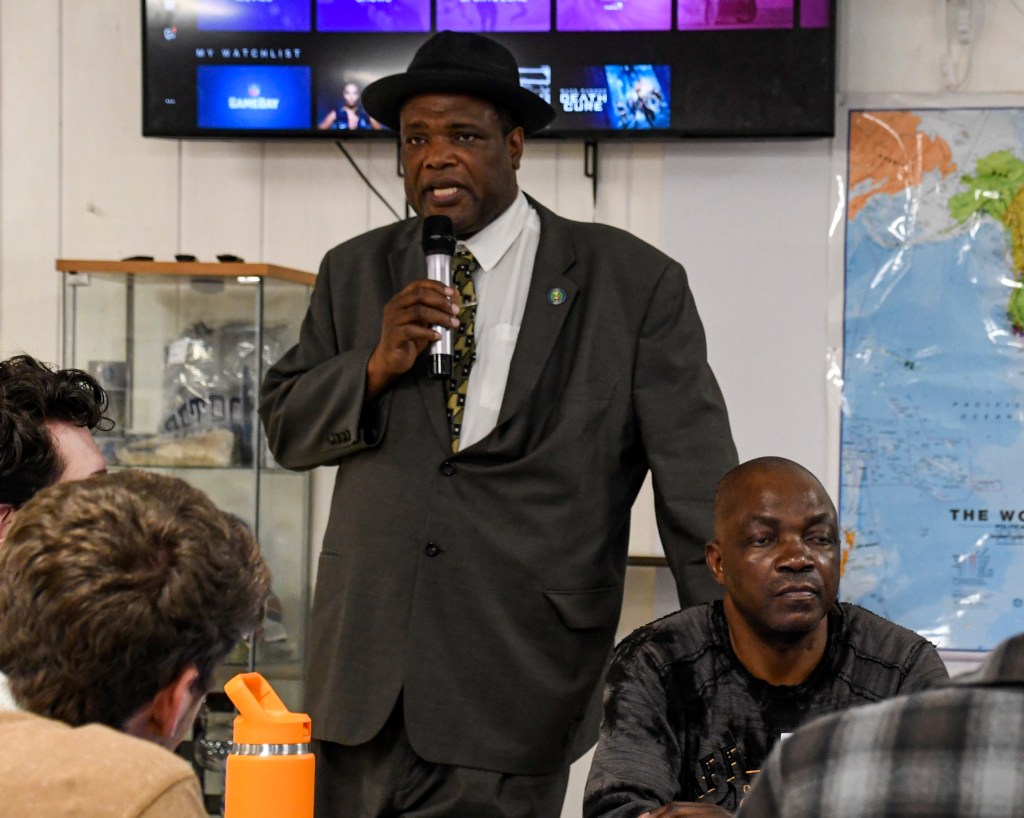
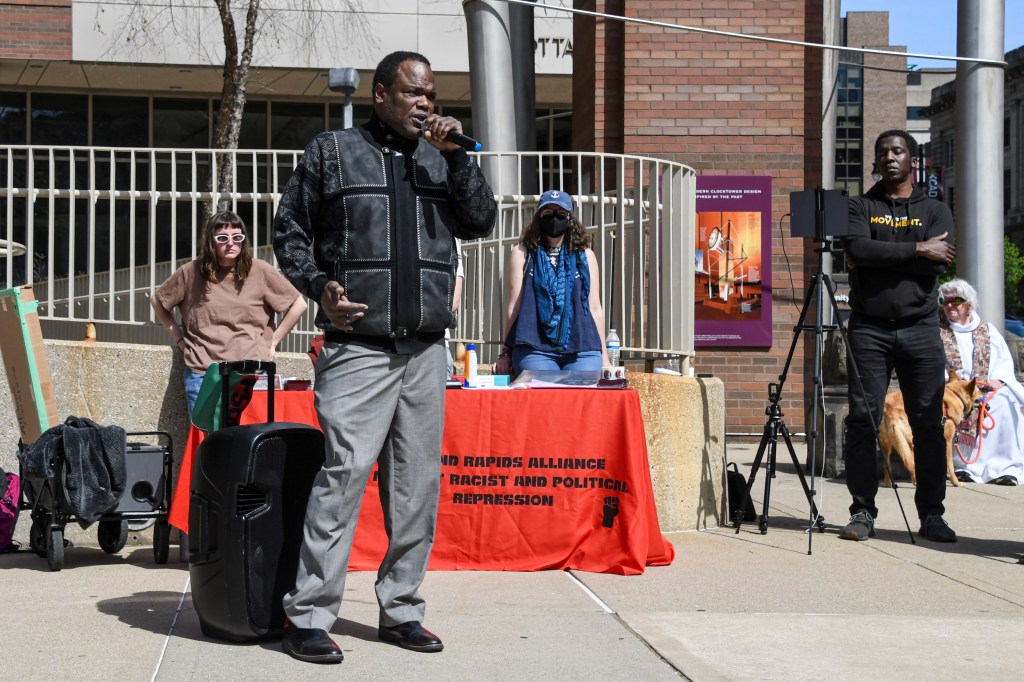
Robert S Womack addressing the crowd at the Meet and Great with the Lyoya family
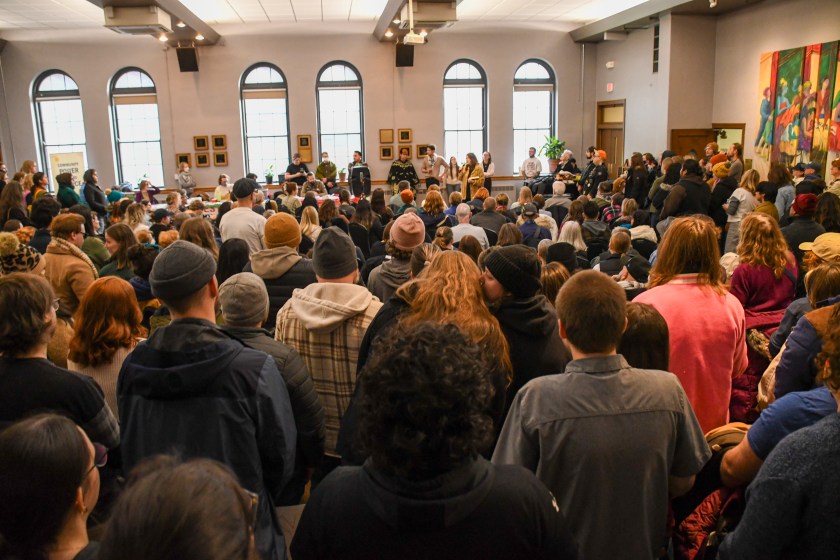
Grand Rapids, MI — Over 50 people gathered Wednesday night May 15, 2025, at Hero’s Shero’s Corner for a grassroots meet-and-greet with the Lyoya family—three years after 26-year-old Patrick Lyoya was killed by a Grand Rapids police officer during a traffic stop gone violently wrong. The event, organized by community members and activists, offered space for collective grief, shared struggle, and renewed demands for justice.
“We and the Lyoya family are the working-class families that will continue to stand up until change has come,” echoed one of the grassroots organizers to the room of supporters. “No matter how dark the night, we can rebuild the day. Step by step, voice by voice, in peace, together.”
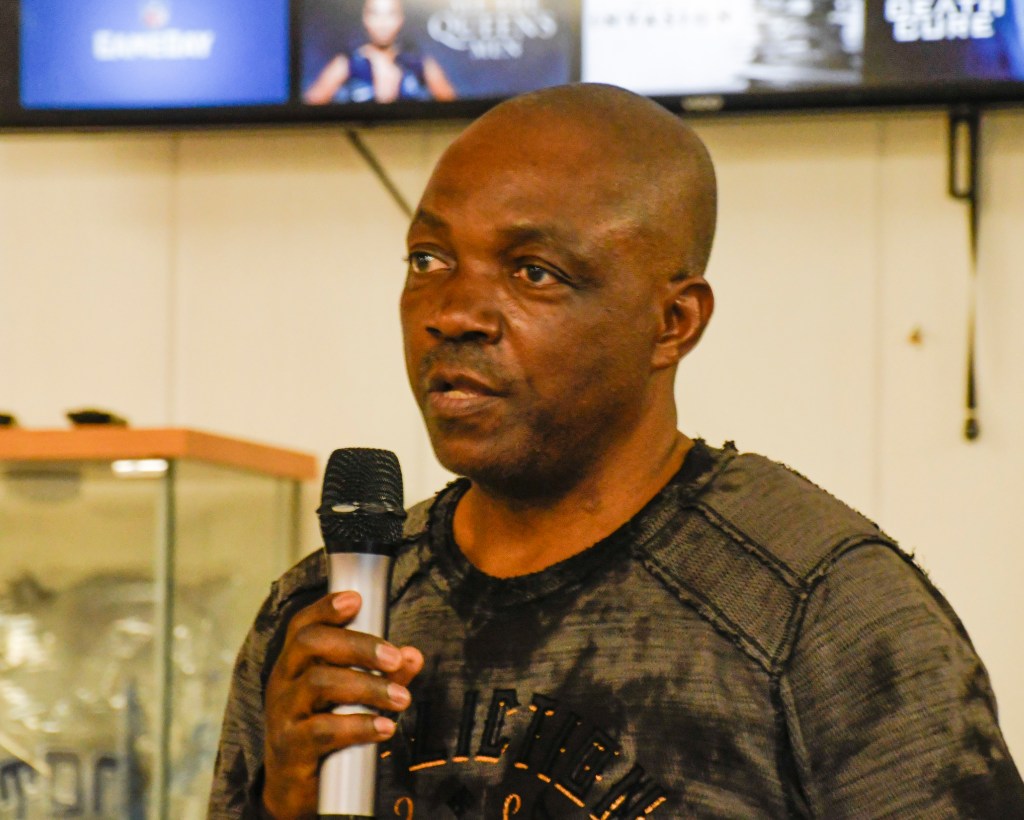
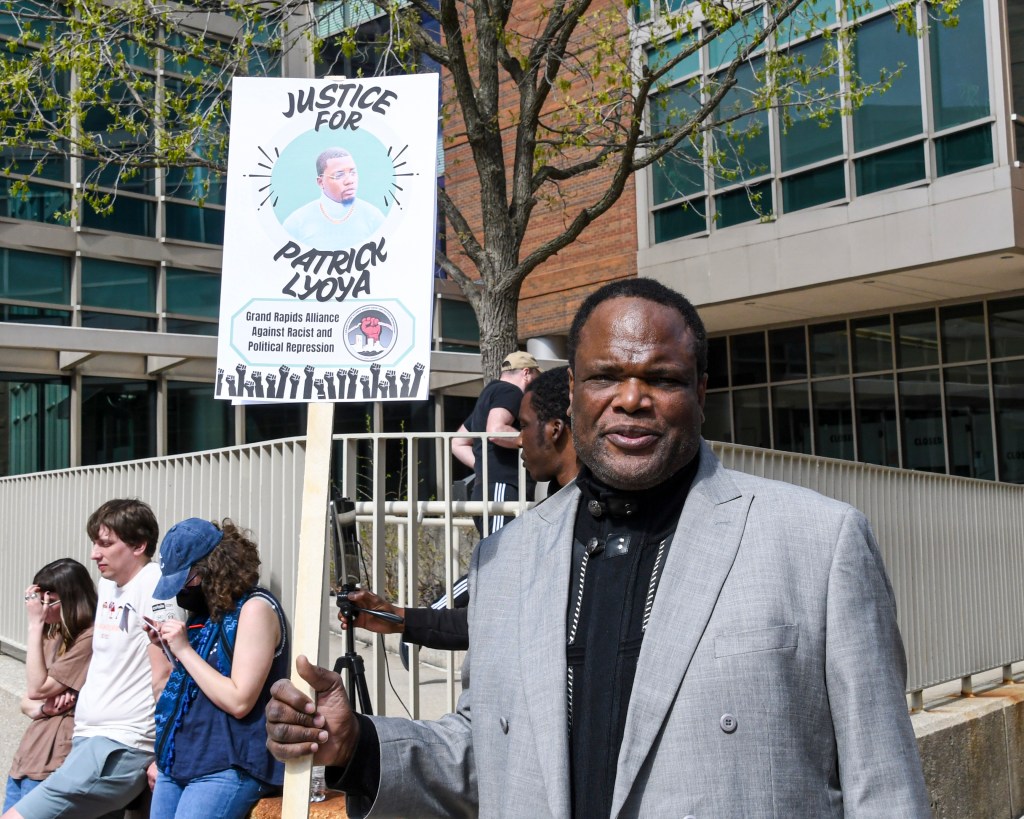
Peter Lyoya, Patrick’s father, stood before the crowd with heavy emotion in his voice.
“My son is three years underground,” he said. “And the man who killed him is still with his family. That is not justice.”
Peter Lyoya Father of Patrick speaking at a meet and great for the family
The recent trial against Officer Christopher Schurr ended in a hung jury. Though Schurr was not acquitted, he also was not convicted, leaving the Lyoya family devastated and community members frustrated.
“We were heartbroken,” Peter continued. “But we will not stop. We will keep fighting until there is justice for Patrick.”
The gathering was as much a vigil as it was a rally. Speakers included Robert S. Womack, Kent County Commissioner, who praised Peter Lyoya for his courage and resilience.
“There were many days I didn’t know how Peter kept going,” said Womack. “This has been a traumatic ordeal for the family—to have to watch that video again and again in court… It’s unbearable. But Peter has not stopped. None of us have.”
Womack noted that conversations with local officials about police reform are ongoing, but emphasized the importance of community-led efforts.
“This was not just a meet-and-greet,” Womack said. “This was about building solidarity. Healing for the family. And it was about saying: ‘Where do we go from here?’”
Members of the Grand Rapids Alliance Against Racist and Political Repression reiterated their demands for an immediate retrial of Officer Schurr and the dismissal of charges against local activists arrested during protests.
“We showed up every day during the trial—bringing water, snacks, support, whatever was needed,” said a representative. “We’ll continue to show up—not just for the Lyoya family but for every family impacted by police violence in Grand Rapids.”
Tom Burke, president of the local stagehands union and co-chair of the local May Day committee, didn’t hold back.
“This trial was a farce. Justice wasn’t served,” said Burke. “If one of us killed a cop, we’d be locked up in seconds. But when the roles are reversed, it takes three years to even get to court—and the system still fails us.”
Burke called for broader systemic reforms, including community control of the police, pointing to reforms happening in places like Chicago, where elected civilian oversight boards are beginning to reshape local policing.
Former Kent County Commissioner and State Senate candidate Ivan Diaz was blunt in his criticism of the justice system, the city leadership, and the culture of policing.
“If it can happen to Patrick, it can happen to any of us,” Diaz warned. “This is about systems of oppression—about a police department that believes it can be judge, jury, and executioner.”
Diaz recounted recent protests, during which police used bicycles to push peaceful demonstrators and even flipped a wheelchair-bound activist. He described being pepper-sprayed while filming the protest live on social media.
“Some of our officials are waiting for the trial to finish before they change policy,” he said. “But we can’t wait. Every day we delay is another day a tragedy could occur.”
Diaz outlined specific policy failures revealed during the trial—such as a lack of requirements to warn suspects before shooting, and no clear guidelines for foot pursuits.
“You can say your policies ‘respect the sanctity of human life’ all you want,” Diaz said. “But if those policies still allow officers to kill without warning, nothing has changed.”
Several speakers connected Patrick Lyoya’s death to broader movements for racial justice, immigrant rights, and working-class solidarity.
“This isn’t just about Patrick,” said Tom Burke. “It’s about every system that preys on poor people, on Black people, on immigrants.”
Burke spoke of the historical legacy of racist policing and the need for community power—not just performative politics.
“These politicians—we can’t rely on them to do the right thing,” he said. “They’ll listen to us and then break our hearts. But we have the power to build movements that change everything.”
He recalled meeting organizer Israel Siku at the first protest in Boston Square after Patrick’s death, and the long journey it’s taken to even get the case to trial.
“I told Israel it would take two years to get justice, and here we are three years later,” Burke said. “But we’re still here. And we’ll keep being here.”
Peter Lyoya closed the event with simple, powerful words.
“I don’t know if justice exists in America,” he said. “But I know we will keep fighting. For my son. For your sons. For all of us.”
The room responded in unison:
“Justice for Patrick. Justice for Patrick. Justice for Patrick”
The Lyoya family, along with their community of supporters, continues to demand a retrial of Officer Schurr and substantive reform within the Grand Rapids Police Department.
But more than anything, they are demanding to be heard—not as an afterthought, but as participants in shaping the systems that govern their lives.
“We are the voices with boots on the ground,” one speaker declared. “We may never be allowed at the table of the bourgeoisie—but we’ll build our own table, and we’ll make it louder.”
If you want to support the Lyoya family or stay updated on justice efforts in Grand Rapids:**
Follow the Grand Rapids Alliance Against Racist and Political Repression
Attend upcoming City Commission meetings and rallies
Demand transparency and accountability from local officials
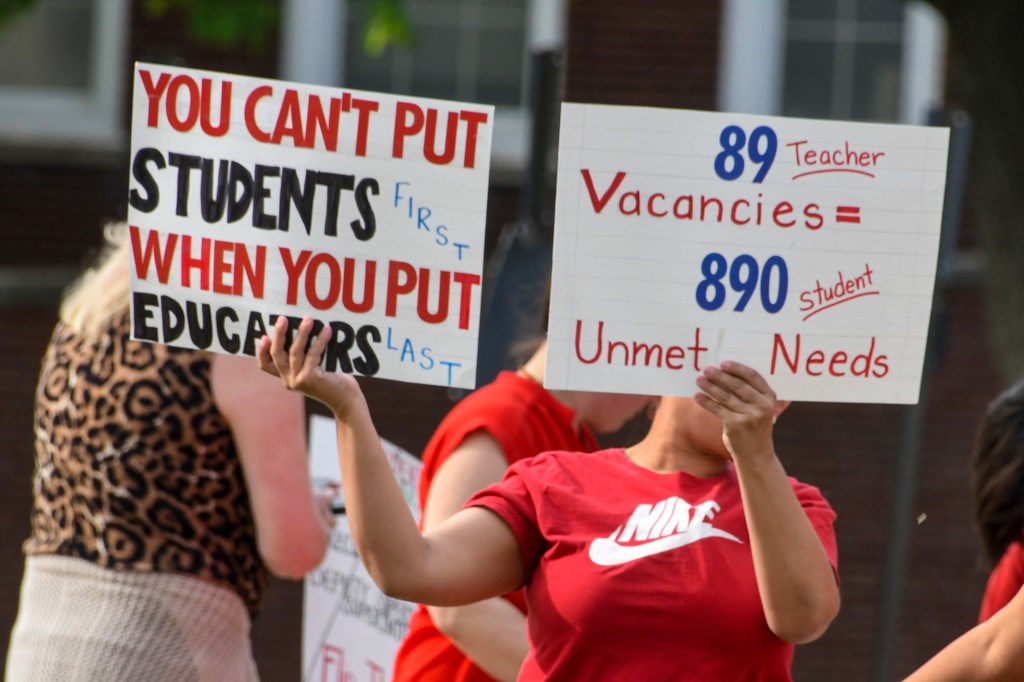
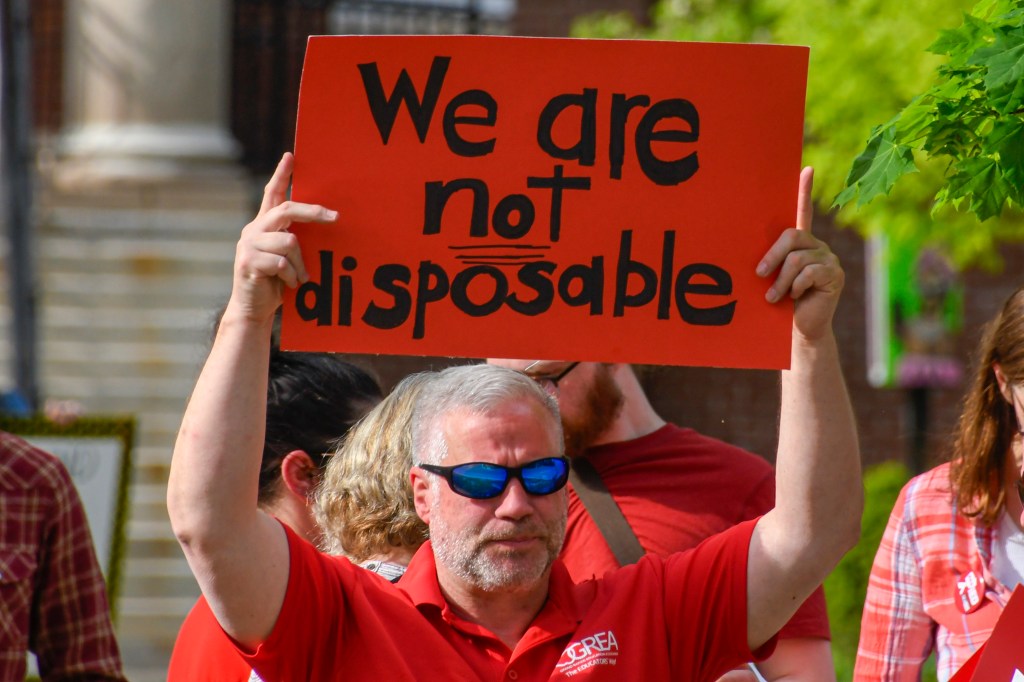
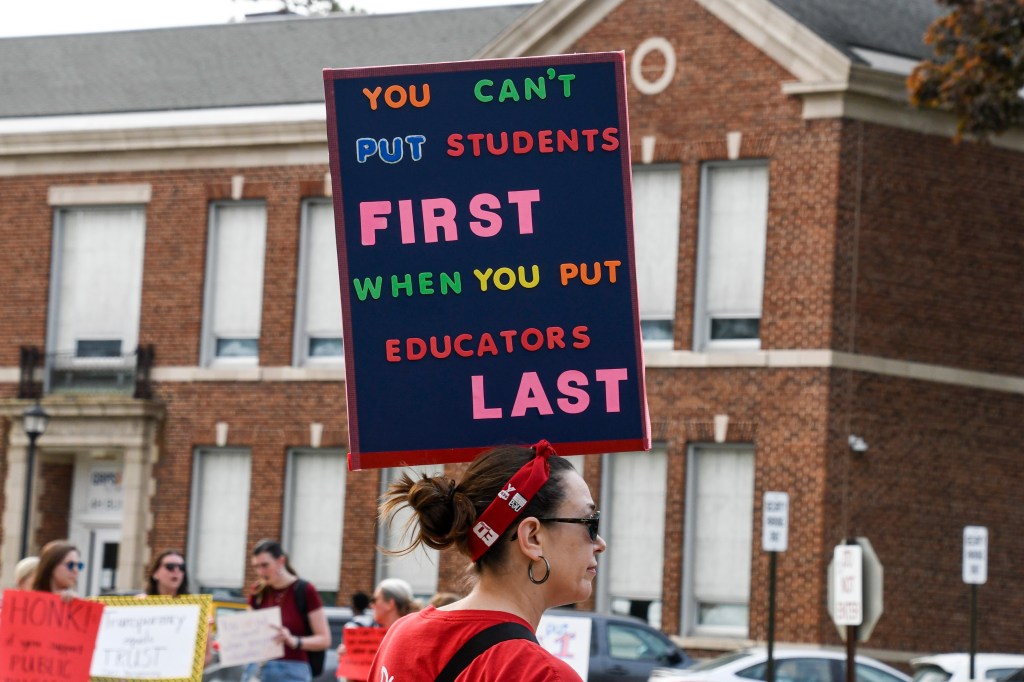
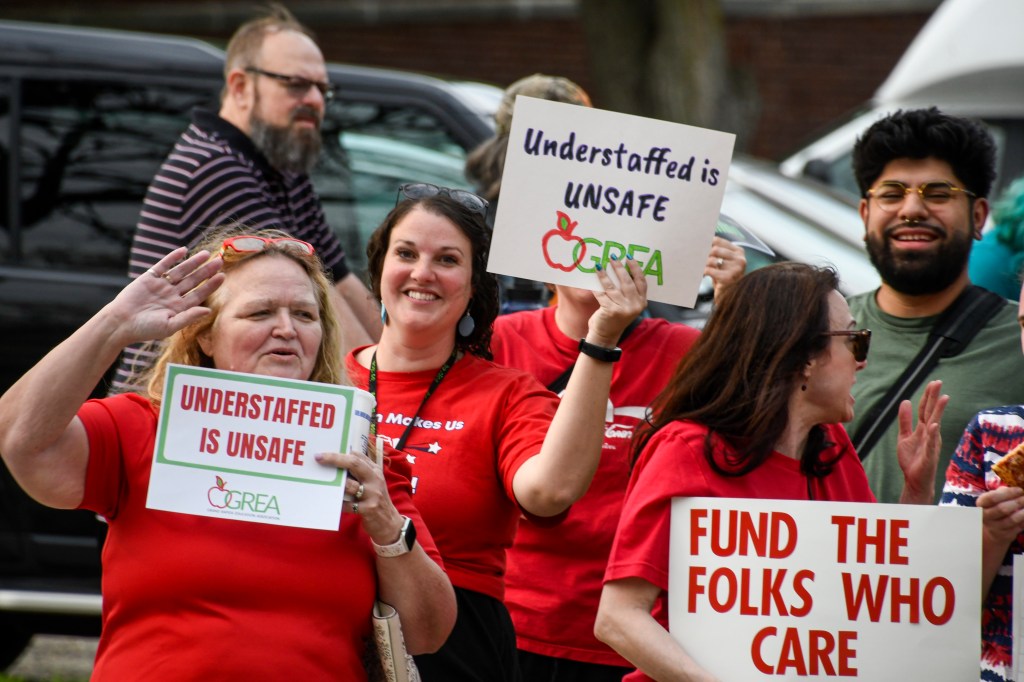
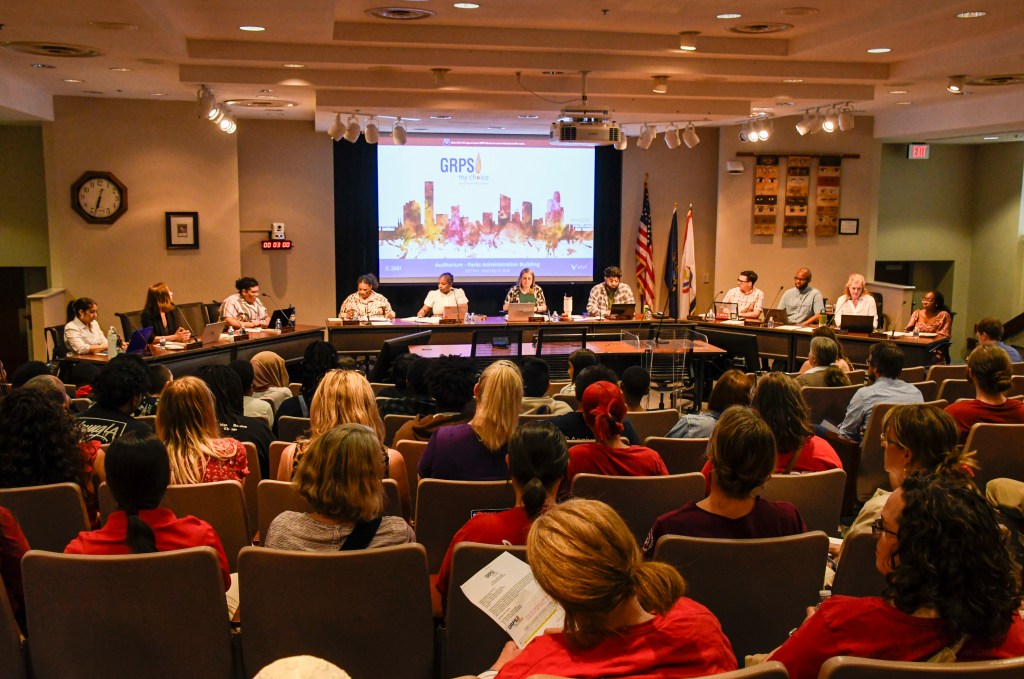
GRAND RAPIDS, MI — More than three dozen Grand Rapids Public Schools (GRPS) teachers and union members gathered outside the district’s main office at 1331 Martin Luther King Jr. Street SE Monday evening, ahead of the school board meeting, calling for a fair contract, stronger collective bargaining rights, and improved classroom conditions. Their current contract expires in June, and negotiations with the district have hit a wall on key issues.
“We’re in a staffing crisis,” said Tim Russ, Unit Service Director with the Michigan Education Association (MEA), who has represented GRPS educators for years. “There are over 100 classrooms being filled by individuals who are not certified teachers. Some only meet the state’s bare minimum requirement for substitutes—60 college credits—and the district doesn’t even budget to fully staff every classroom.”
Educators and union leaders from the Grand Rapids Education Association (GREA) are pressing for increased starting salaries to help attract and retain qualified teachers. Currently, GRPS teachers start at $44,916 a year—well below nearby districts. Forest Hills Public Schools, for example, recently ratified a contract bringing starting salaries up to $51,000.
“That’s nearly a $6,000 difference right off the bat,” Russ noted. “We wonder why we can’t fill positions in Grand Rapids.”
But pay is just one part of a broader push to address inequities in the district—particularly when it comes to access to art, music, physical education, and world languages. Some GRPS schools, according to GREA, barely receive these specialized classes because the limited number of instructors are often pulled to serve as substitutes elsewhere. Meanwhile, magnet and theme schools in the same district receive these classes multiple times per week.
“All of our suburban competitors offer four to five hours a week of specialized instruction,” Russ said. “We’re asking for equity, not luxury.”
Teachers have also been pushing the district to respond to a major legal shift that returned key bargaining topics to the table. In 2012, Michigan lawmakers banned collective bargaining over issues like teacher evaluations, discipline, and placement. That ban was repealed in 2023, restoring those rights to educators. Since February 2024, the union has been working to incorporate those provisions into the new contract—but says progress has been slow and frustrating.
“The district agreed to biennial evaluations,” Russ explained, “but they still want full control over when to put a teacher on an Individual Development Plan (IDP), which is essentially a formal warning that you’re not doing your job. There’s no accountability or fairness in that system.”
Jayne Niemann, vice president of GREA, said the current evaluation system heavily relies on standardized test scores, often disregarding the challenging realities faced by students.
“I had a student who couldn’t test because he was in crisis over a serious family issue,” Niemann said. “Others are falling asleep during tests because they wake up at 4 a.m. to catch the bus. And yet, those are the scores being used to judge my effectiveness as a teacher.”
Beyond the classroom, educators are also calling for more say in school-level leadership decisions and a return of the “right to home”—the ability for experienced teachers to return to buildings where they’ve taught and built strong relationships.
“Many building leaders don’t have classroom experience,” Niemann added. “Teachers are being micromanaged and disrespected by people who don’t understand what we do every day.”
Meanwhile, the district’s latest proposal includes only a 1.5% salary increase for teachers—significantly less than the 3% raise granted to other employee groups. Union leaders argue this offer is being used as leverage to push through evaluation and placement language that educators find unacceptable.
“They’re holding our raise hostage,” Russ said. “We already had a 1.5% increase from three years ago. The district is now tying the additional 1.5% to language that limits our rights on evaluations and teacher placement—topics we just got back the right to negotiate.”
The frustration is palpable among GRPS educators, many of whom say they’re sacrificing their financial futures and retirement security to serve students in a district with high needs—and little support.
“What’s the incentive to stay?” Niemann asked. “We’re working with kids who experience trauma, poverty, and daily challenges. We’re not asking for more than what other districts are getting—we’re asking to be treated like professionals. If you can’t pay teachers fairly, at least give them back their rights and some dignity.”
The GREA’s top demand at this stage is open bargaining—a transparent process that would allow the public to observe contract negotiations in real time.
“Our number one ask of the school board is simple,” Russ said. “Let the public see what’s happening. We believe that if the community could watch these negotiations unfold, they’d understand exactly why we’re standing out here demanding change.”
With the June deadline approaching and no deal in sight, Grand Rapids educators say they are prepared to keep raising their voices—until they are truly heard.
State Representative James DeSana, R-Carleton, held a press conference Monday morning, April 28, in front of the Kent County Courthouse to unveil House Bill 4404
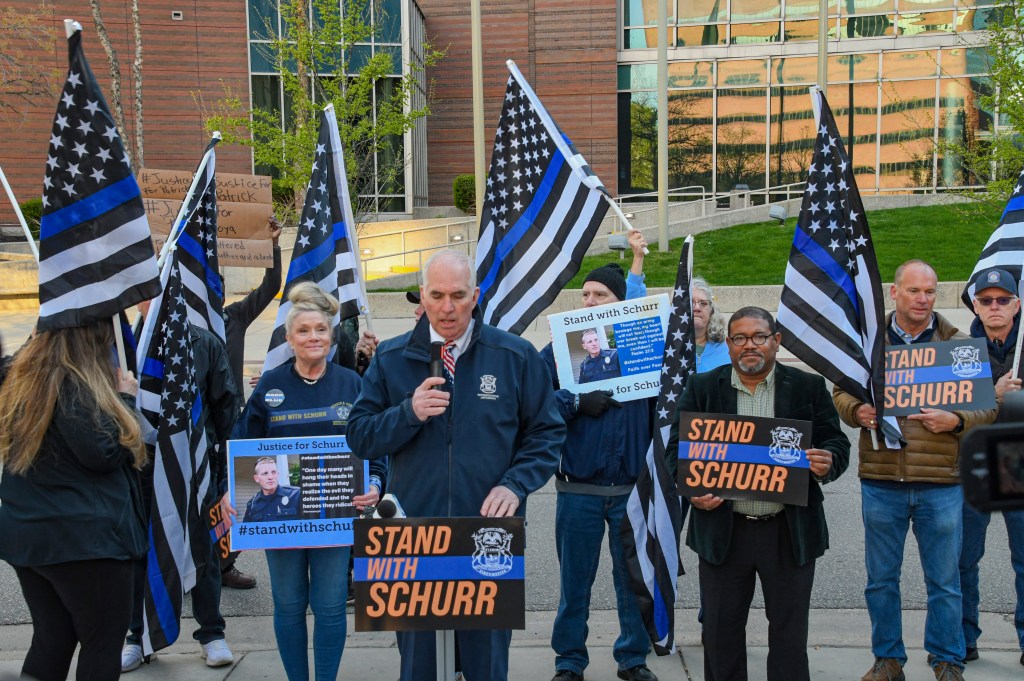
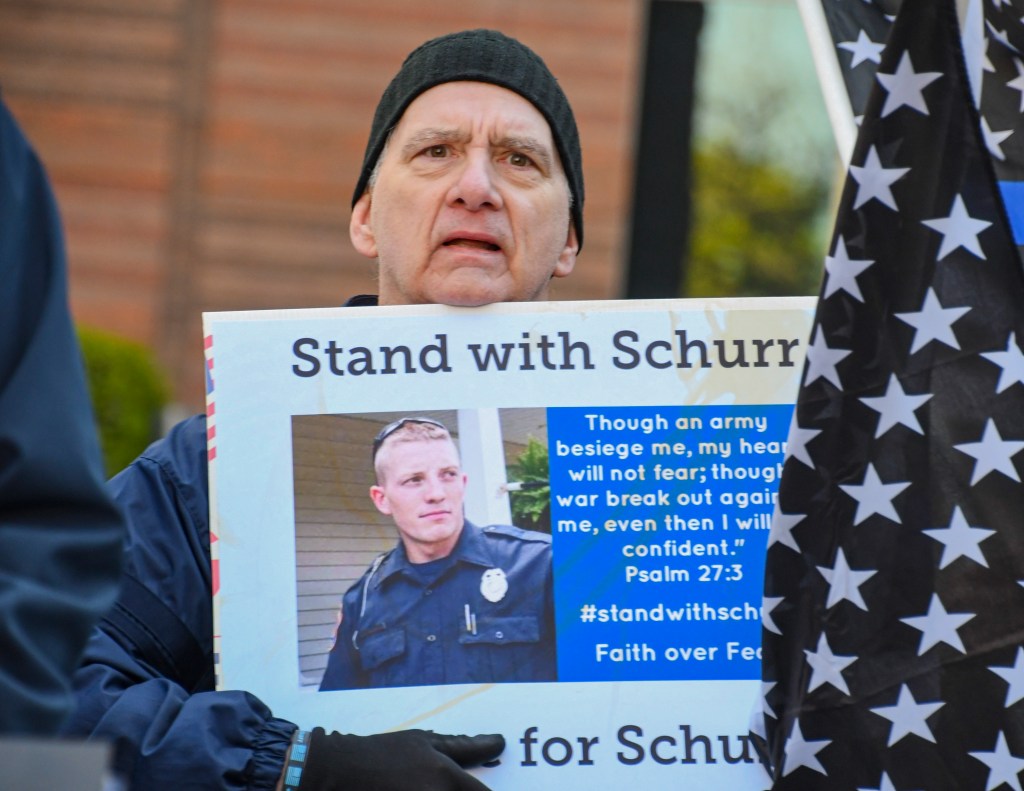
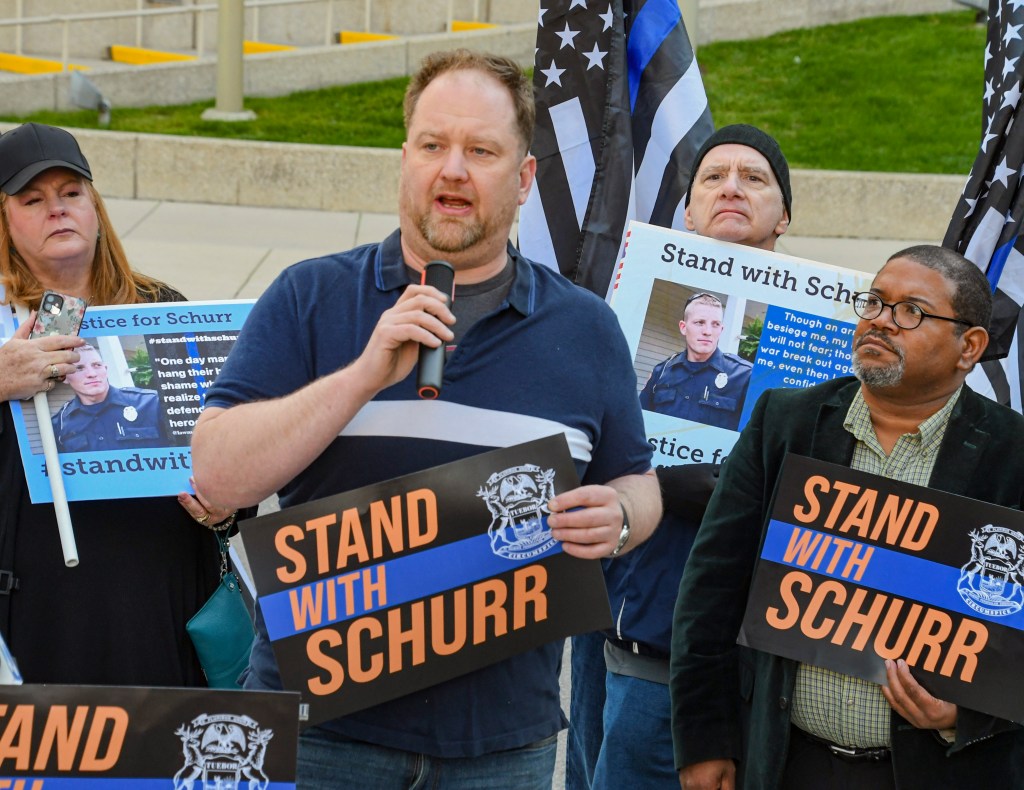
Grand Rapids, MI -As former Grand Rapids police officer Christopher Schurr stands trial for second-degree murder in the 2022 shooting of Patrick Lyoya, a Michigan state lawmaker is pushing for new legislation that would shield police officers from civil lawsuits when cleared of criminal wrongdoing in self-defense incidents.
State Representative James DeSana, R-Carleton, held a press conference Monday morning, April 28, in front of the Kent County Courthouse to unveil House Bill 4404. The proposed legislation would create a presumption of civil immunity for individuals—especially law enforcement officers—who use force in self-defense and are found not guilty or not charged in criminal court.
Schurr is accused of fatally shooting 26-year-old Patrick Lyoya, a Congolese immigrant, during a traffic stop that escalated into a physical struggle over the officer’s Taser. Schurr shot Lyoya in the back of the head while on top of him.
“This officer does not deserve what is happening to him today,” DeSana said during the announcement. “We are here to stand with him and every police officer in the state of Michigan.”
Bill Would Shift Burden in Civil Cases
Under current Michigan law, even if a person is cleared of criminal charges, they can still be sued in civil court. House Bill 4404 aims to reverse that presumption by shifting the burden of proof onto the plaintiff.
“It will make Michigan self-defense protections among the strongest in the nation,” said DeSana. “House Bill 4404 fixes the current system by creating a presumption of civil immunity after a favorable criminal outcome.”
The bill also promises full recovery of legal costs for defendants found immune—including attorney fees, court costs, and lost wages. It further expands protections to include threatened use of force, which current laws do not clearly address.
Catholic Teaching Cited
In a unique turn, DeSana cited the Catechism of the Catholic Church to defend Schurr’s actions. He pointed to Articles 2263, 2264, and 2265, which describe self-defense as both morally legitimate and, in some cases, a grave duty—especially for those tasked with protecting others.
“These exact circumstances existed for Officer Christopher Schurr,” DeSana said. “A person didn’t comply with an officer’s repeated orders, engaged the officer violently, and tried to take his Taser. This is not the result any of us want, but self-defense in such cases is morally justified.”
DeSana also recounted advice given in his own concealed pistol license class, where police officers instruct civilians to aim for the center of mass and eliminate the threat when faced with imminent danger.
Schurr Supporters Speak Out
DeSana was joined by Adam de Angeli, founder of the Coalition to Rescue Michigan. De Angeli strongly criticized the prosecution of Schurr and questioned why the case had advanced to trial at all.
“Christopher Schurr is an innocent man, and the video evidence proves it,” de Angeli said. “Patrick Lyoya disobeyed every command the officer gave, fought him hand-to-hand, and attempted to take his Taser—a deadly weapon in unlawful hands.”
He warned that the prosecution could have a chilling effect on law enforcement officers across Michigan.
“Every police officer in Michigan will pay the price for this,” he said. “They’ll fear that using their own weapon in self-defense might destroy their career and life. That’s a public safety concern for every citizen.”
Public Reaction Mixed
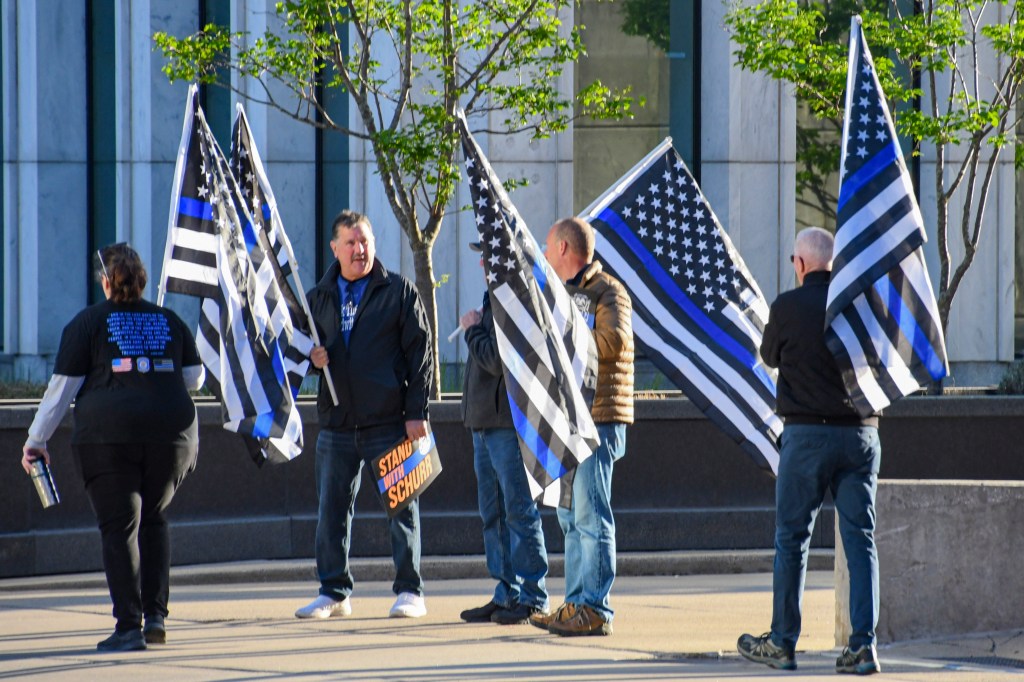
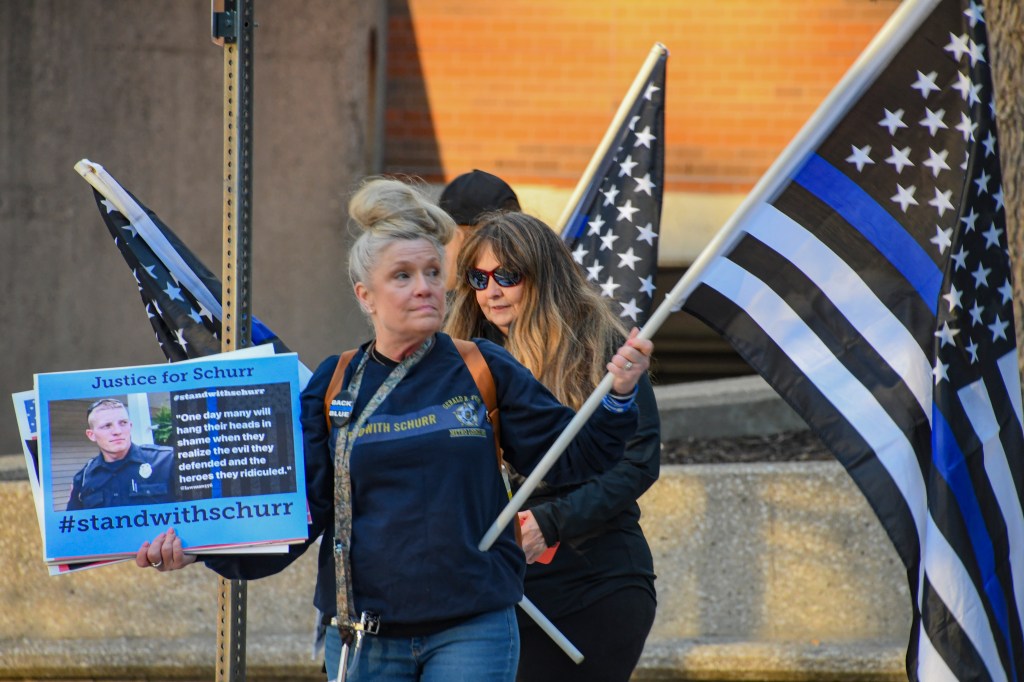
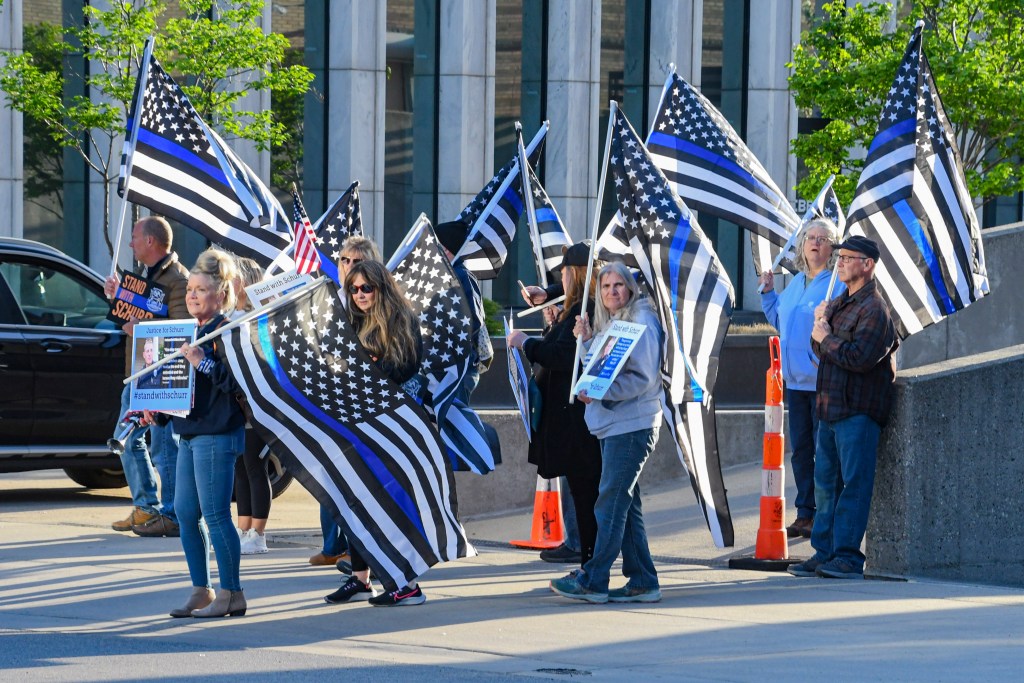
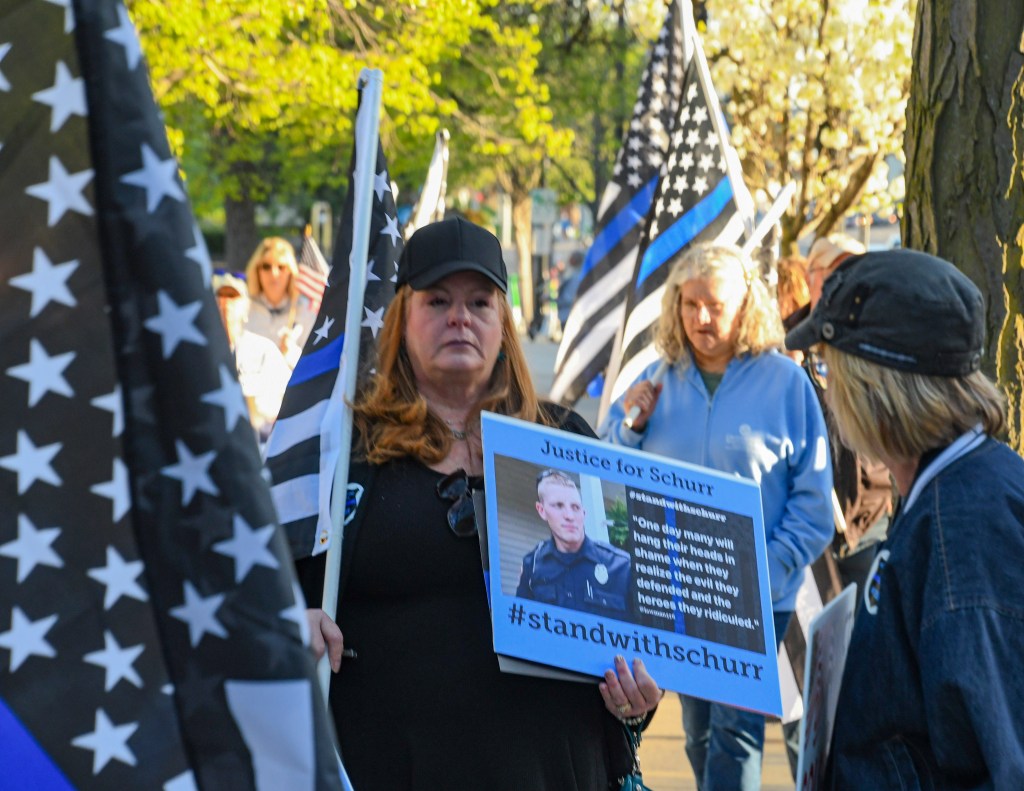
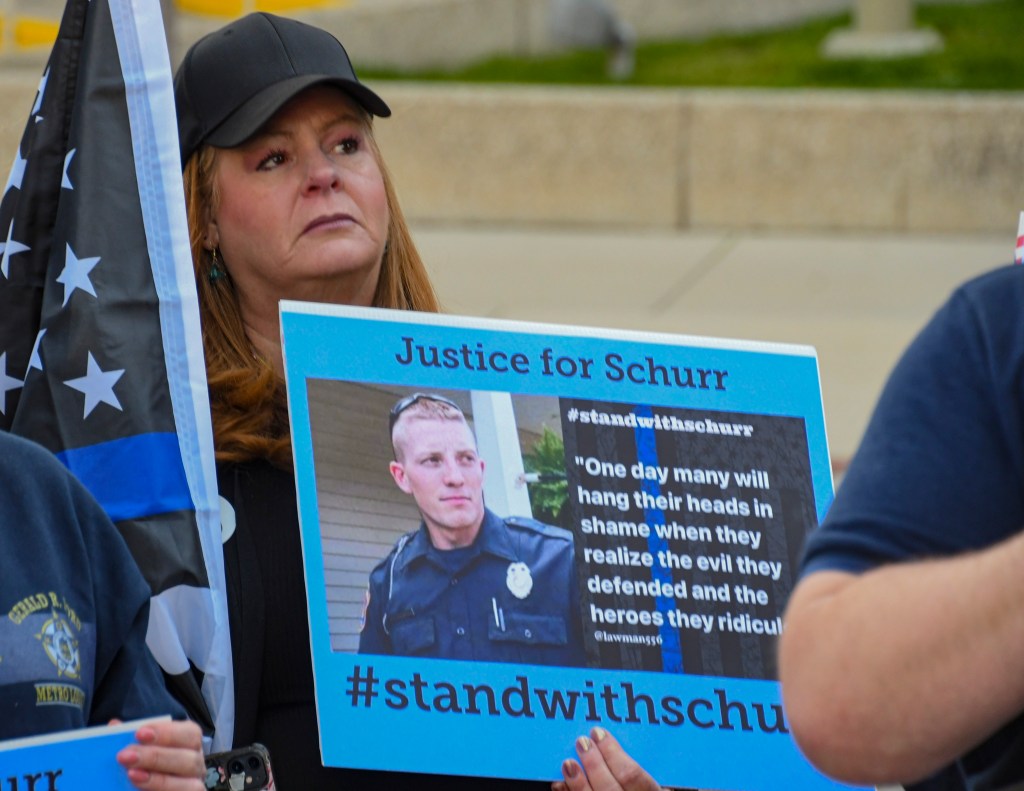
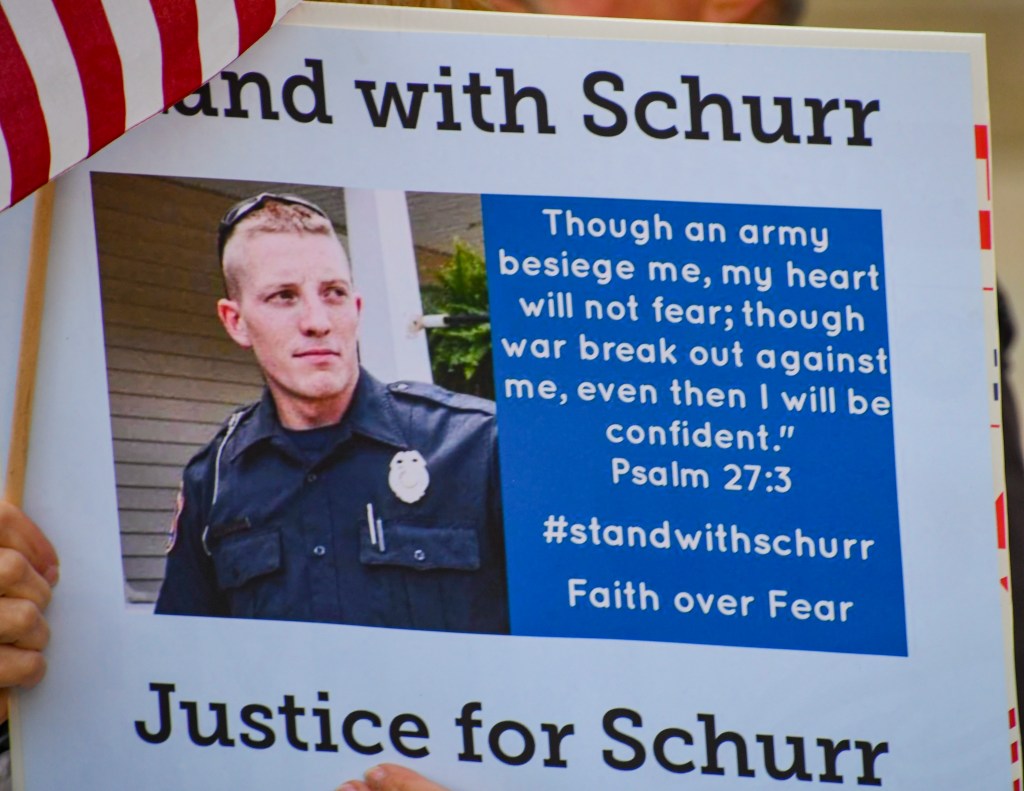
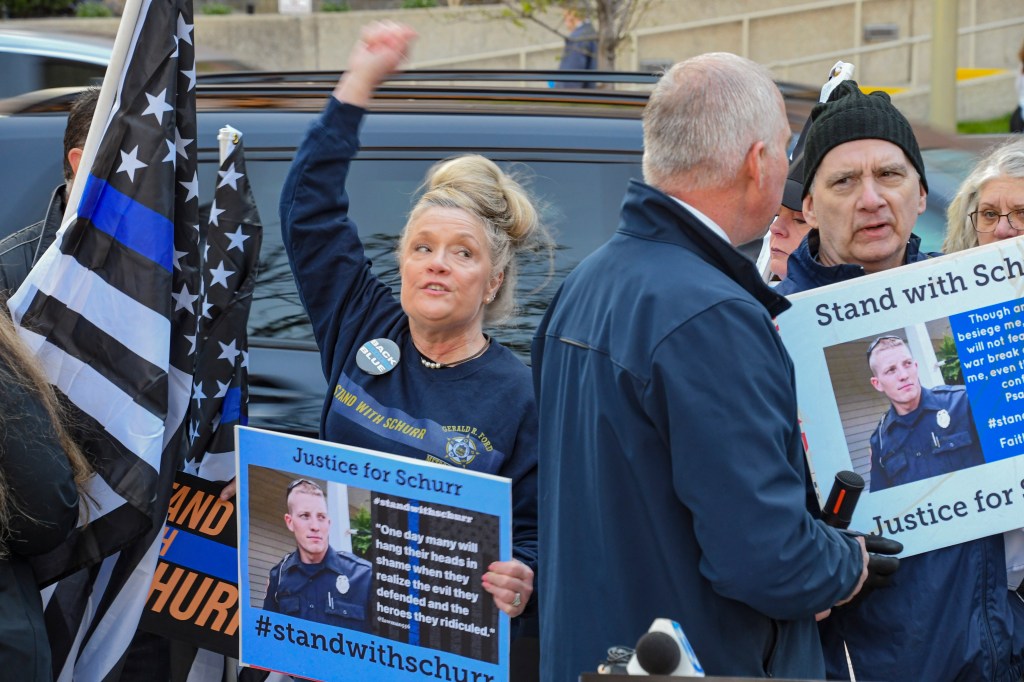
About a dozen supporters, many holding “Back the Blue” flags, gathered alongside DeSana during the press conference. Afterward, they lined the sidewalk outside the courthouse to show support for Schurr. Some passing drivers honked in solidarity, while others voiced their opposition.
The case continues to polarize the Grand Rapids community. Many civil rights advocates view the shooting as unjustified and argue that Lyoya, who was unarmed, should not have been met with lethal force. They are also deeply concerned about the proposed legislation.
“This bill would create a legal shield that lets bad actors in law enforcement avoid consequences,” said one protester outside the courthouse. “If you can’t sue, even when the system fails to convict, what recourse is left for victims and their families?”
What Comes Next
House Bill 4404 has not yet been formally introduced in the Michigan House of Representatives, and it remains to be seen how much legislative support it will garner. DeSana and his allies say the bill is a necessary step to protect officers who put themselves in harm’s way. Critics argue that it could erode public trust in law enforcement and eliminate a crucial check on the use of force.
As Schurr’s trial continues, House Bill 4404 is certain to add fuel to the broader state and national debates around policing, self-defense, and civil rights.
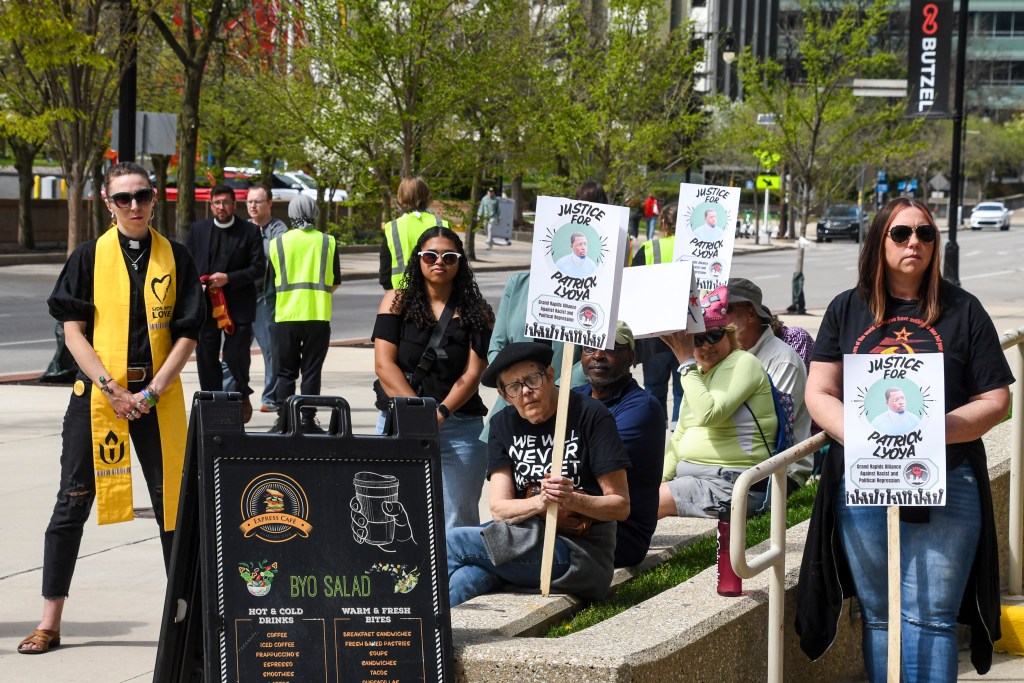
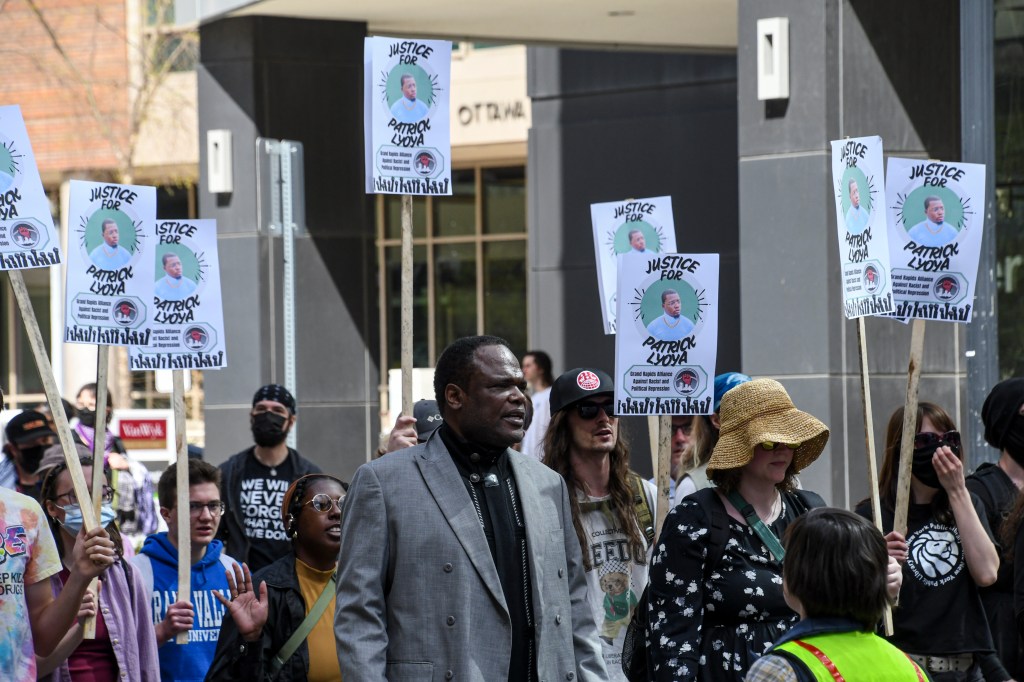
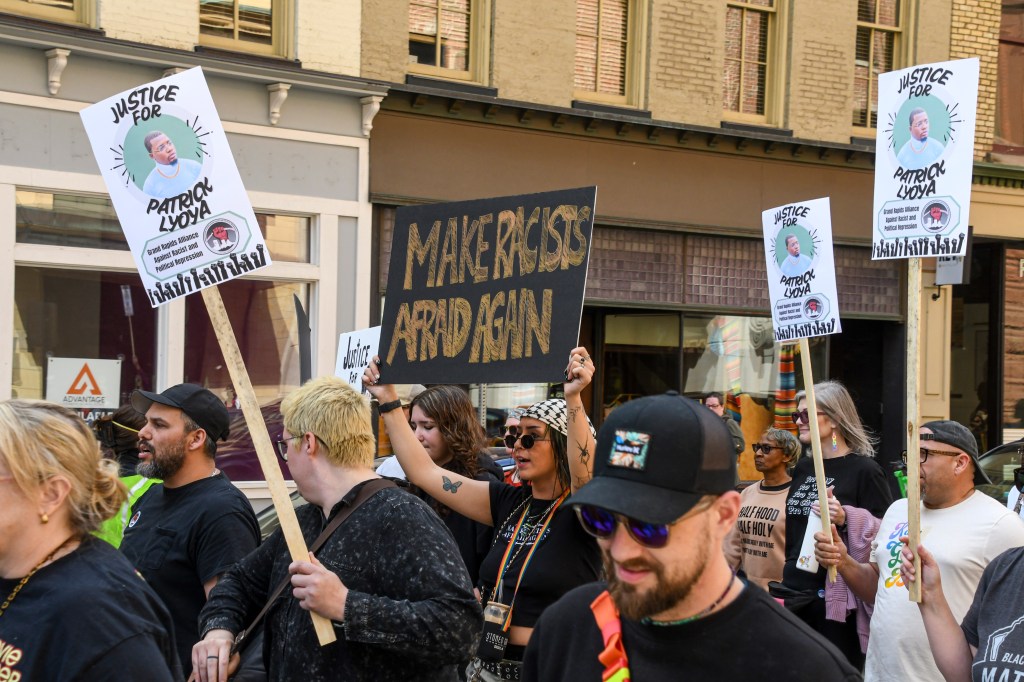
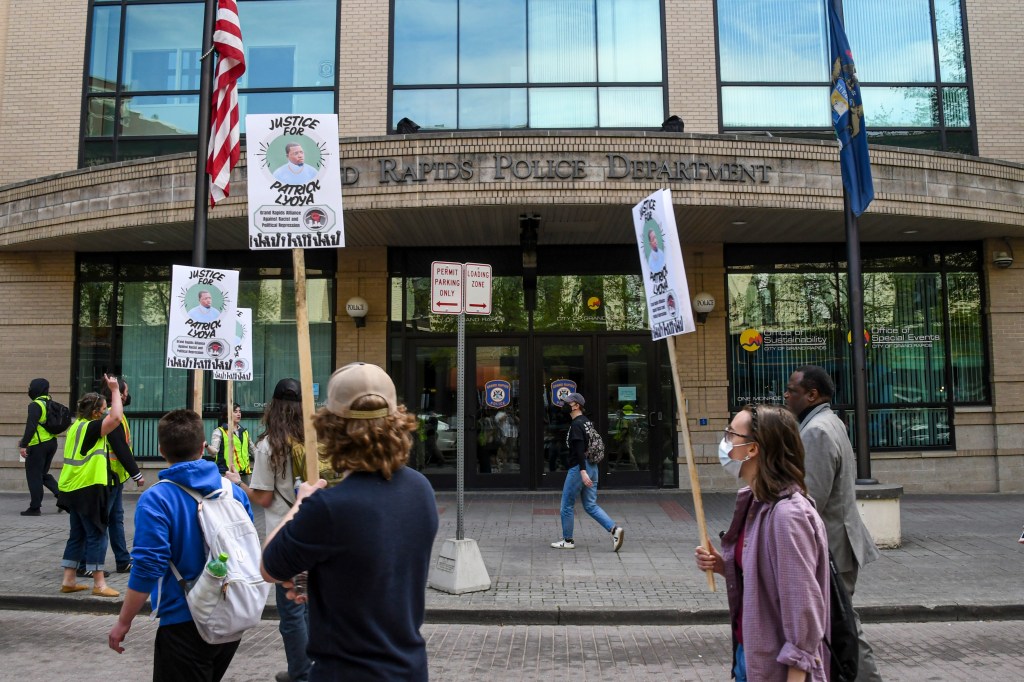
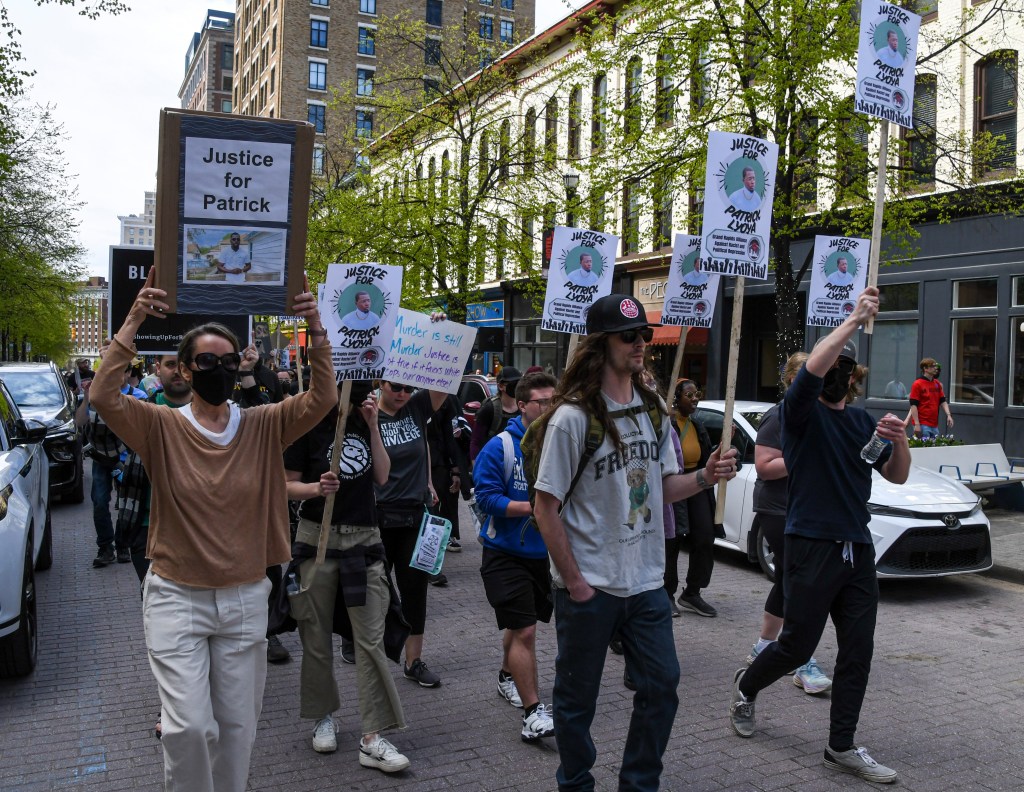
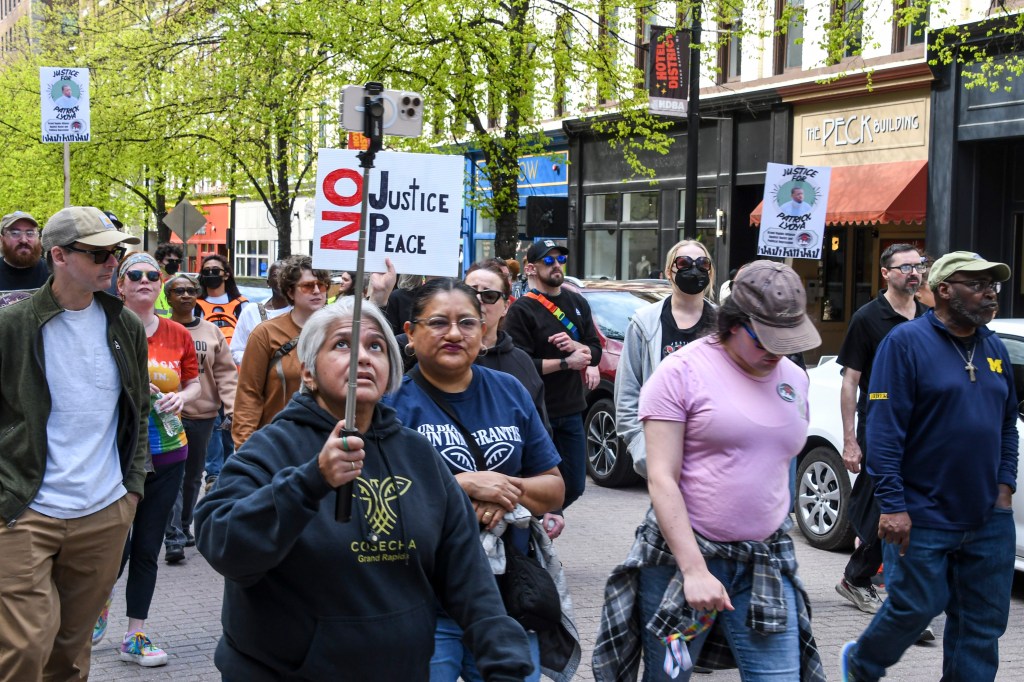
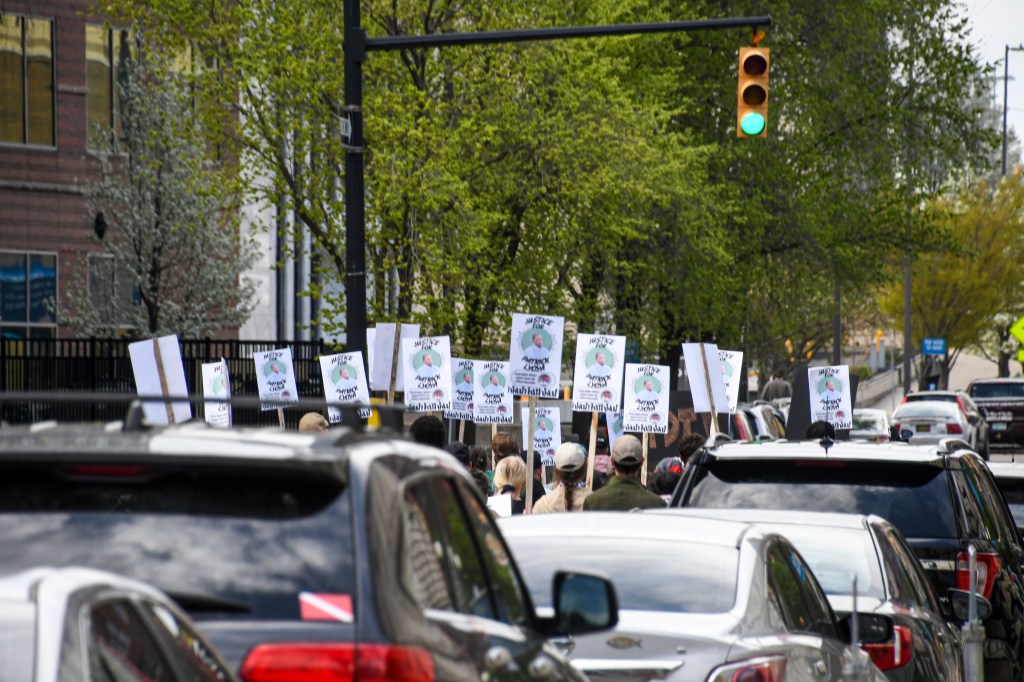
GRAND RAPIDS, MI — The streets of downtown Grand Rapids echoed with chants of “Justice for Patrick” on Sunday as more than 100 protesters gathered in a show of solidarity ahead of a long-awaited murder trial.
Demonstrators rallied outside the Kent County Courthouse to honor Patrick Lyoya, a 26-year-old Congolese immigrant who was fatally shot by former Grand Rapids Police Officer Christopher Schurr in 2022. After nearly three years of court delays and public outcry, Schurr’s second-degree murder trial is set to begin Monday morning.
Lyoya was killed during a traffic stop on the city’s southeast side when Schurr pulled him over for a mismatched license plate. After a brief foot chase and a struggle over a Taser, Schurr who is white shot Lyoya — who was unarmed — in the back of the head.
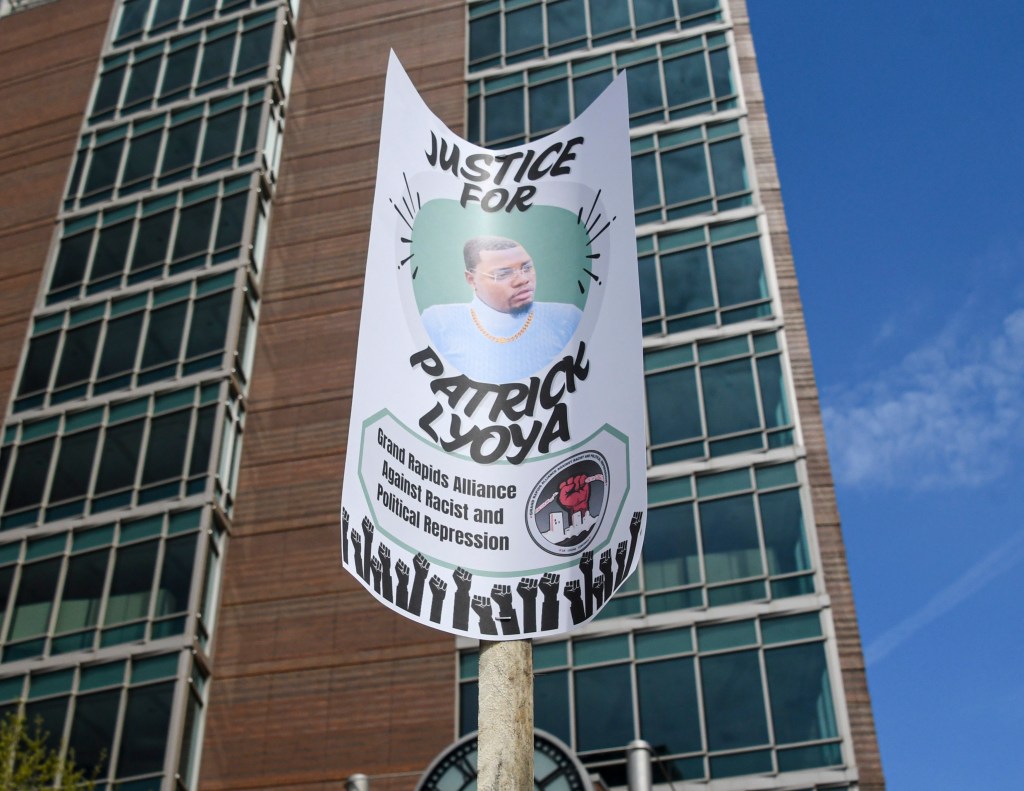
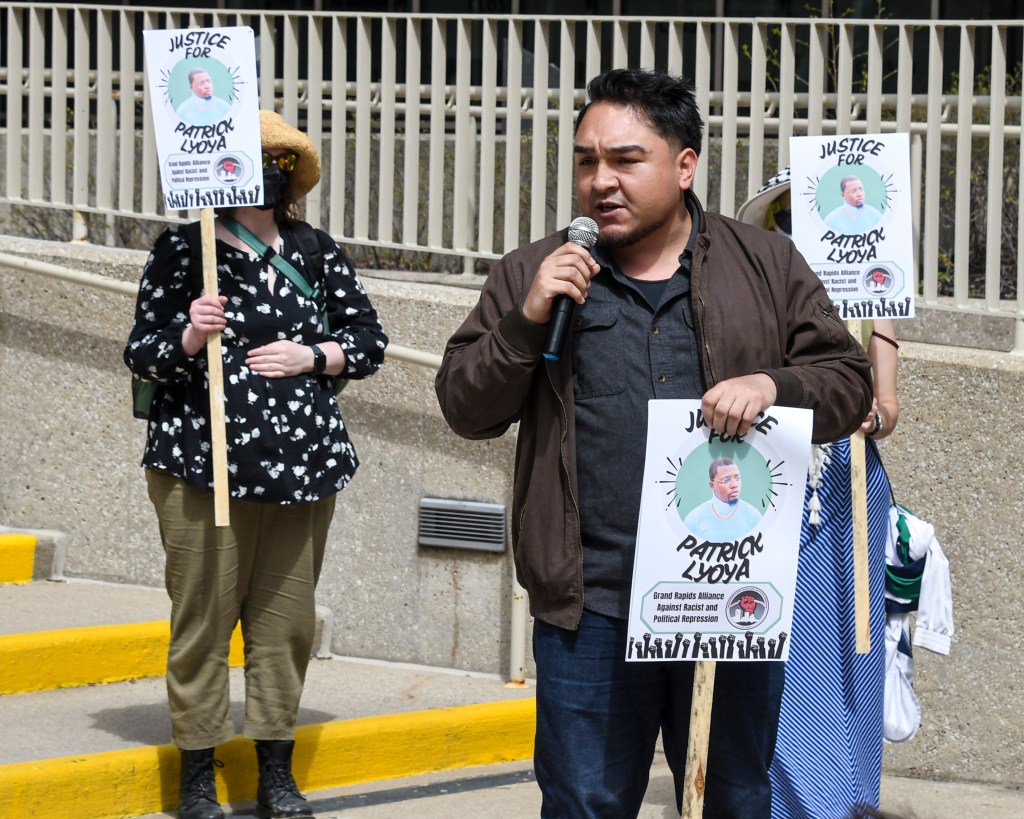
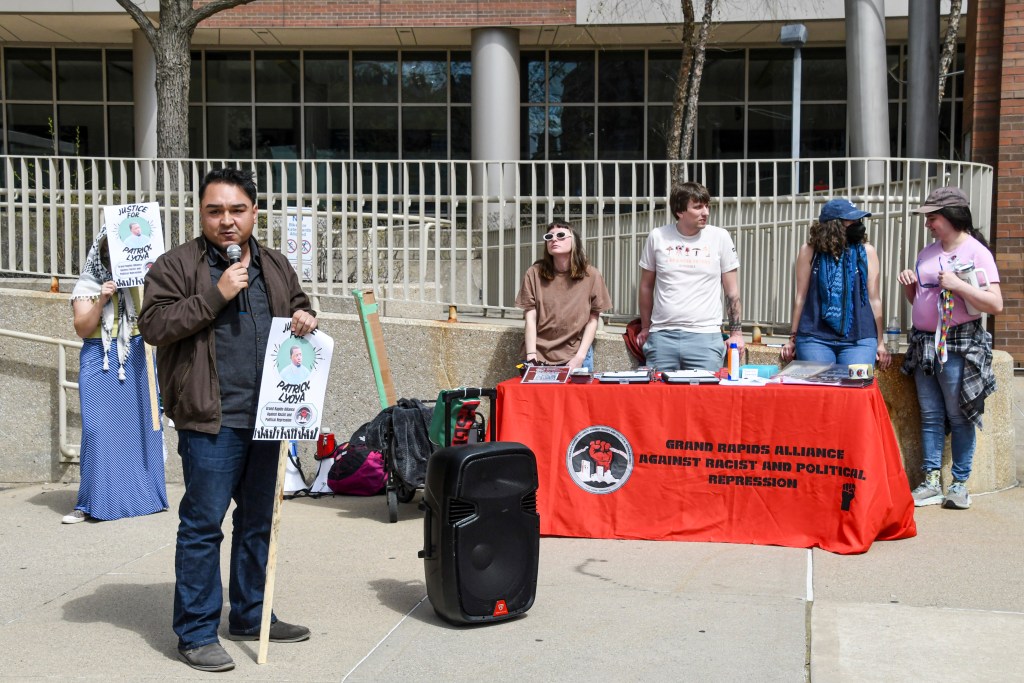
Sunday’s protest was organized by the Grand Rapids Alliance Against Racist and Political Repression. Speakers included Ivan Diaz, a former Kent County commissioner now running for the Michigan Senate, and Robert Womack, a current county commissioner.
“Convicting Schurr will be a victory for Patrick’s family, but the fight doesn’t end there,” said Sam Tunningley, a leader with the organizing group. “Justice means reforming a system that allows this to happen.”
Protesters also remembered other recent tragedies involving local law enforcement, including the deaths of Riley Doggett and Samuel Sterling. The community’s frustration was palpable, with many voicing concerns that justice continues to be delayed or denied for marginalized groups.
“If it can happen to Patrick, it can happen to any of us,” Diaz warned, criticizing rhetoric that blames victims for their own deaths.
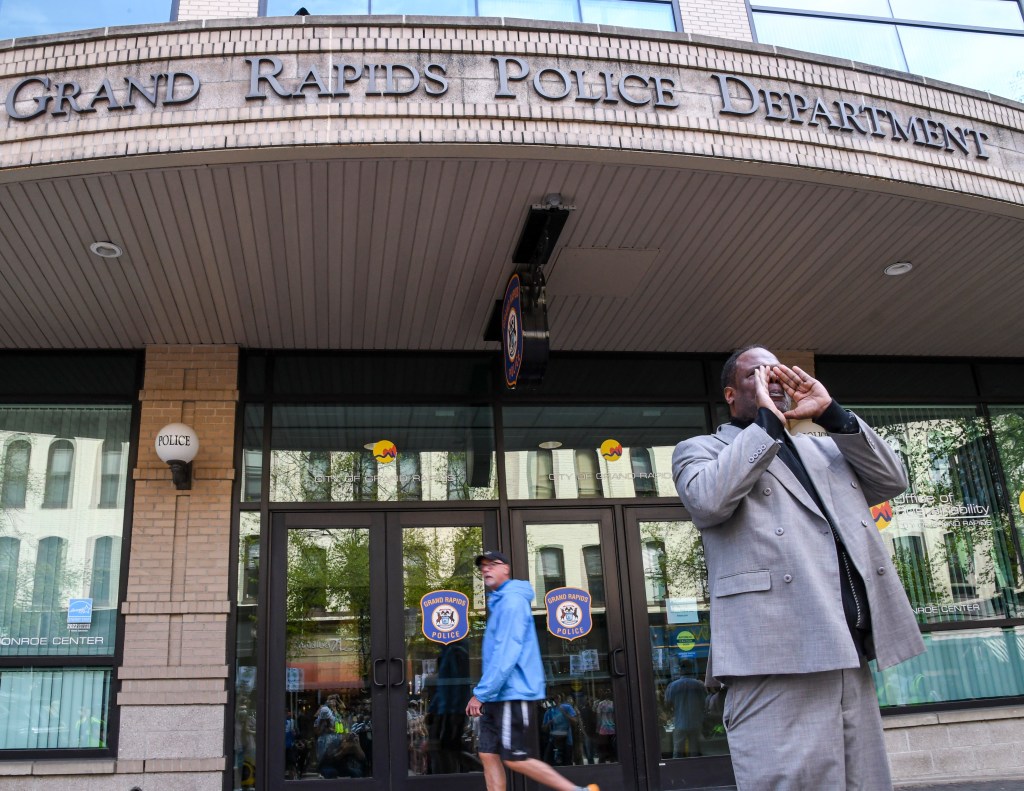
After the rally, the group marched through downtown, stopping in front of the Grand Rapids Police Department and chanting, “No justice, no peace! Justice for Patrick!” Many in the crowd expressed demands not only for justice in Lyoya’s case but for broader systemic change.
As Schurr’s trial begins, protesters vow to keep up the pressure — not just for a conviction, but for meaningful reform.
Demonstrations are set to continue Monday morning, with protesters gathering in front of the courthouse as opening statements get underway.
A separate rally is also planned at 8:30 a.m. at Calder Plaza where State Representative James DeSana (R-Carleton) will introduced a bill that would grant police officers expanded “qualified immunity,” potentially shielding them from lawsuits — a move that critics say would make achieving justice in cases like Lyoya’s even harder.
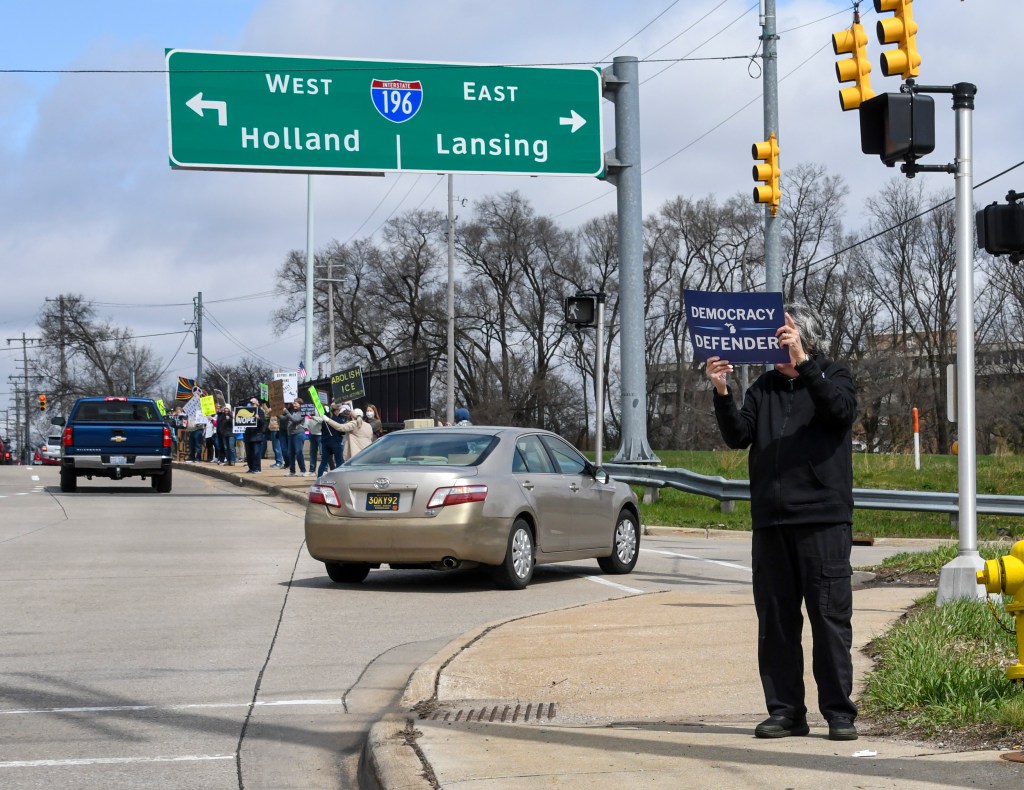
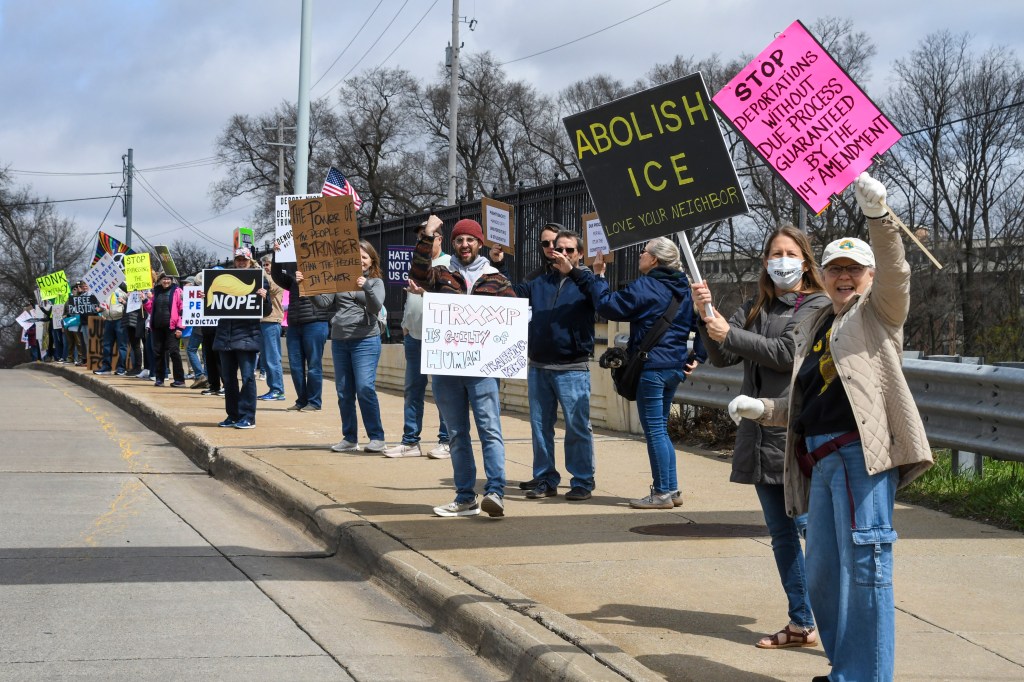
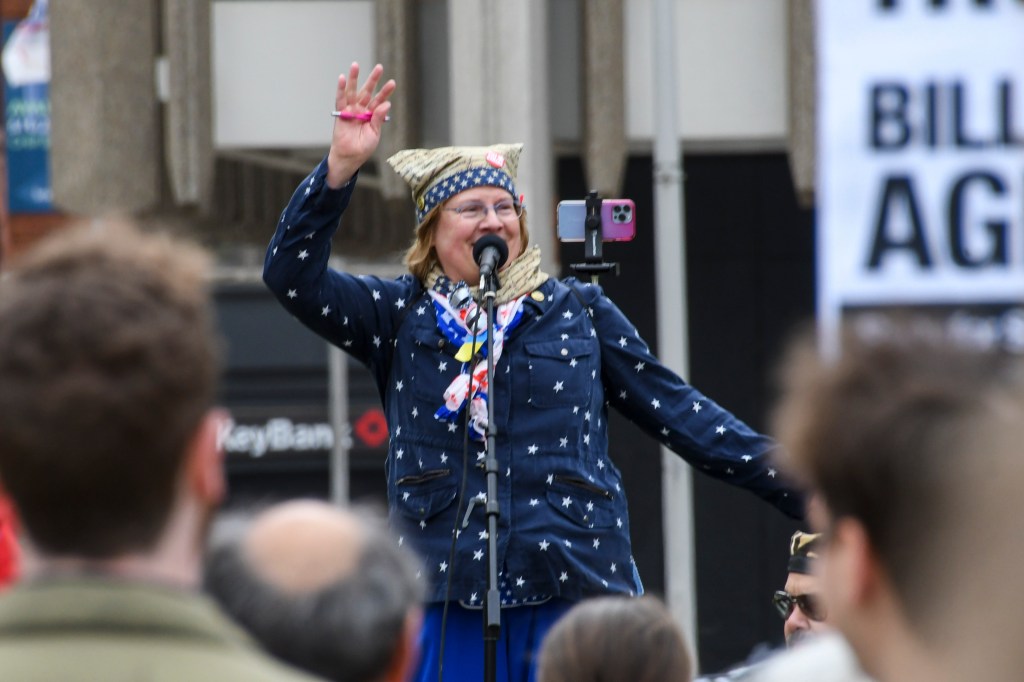
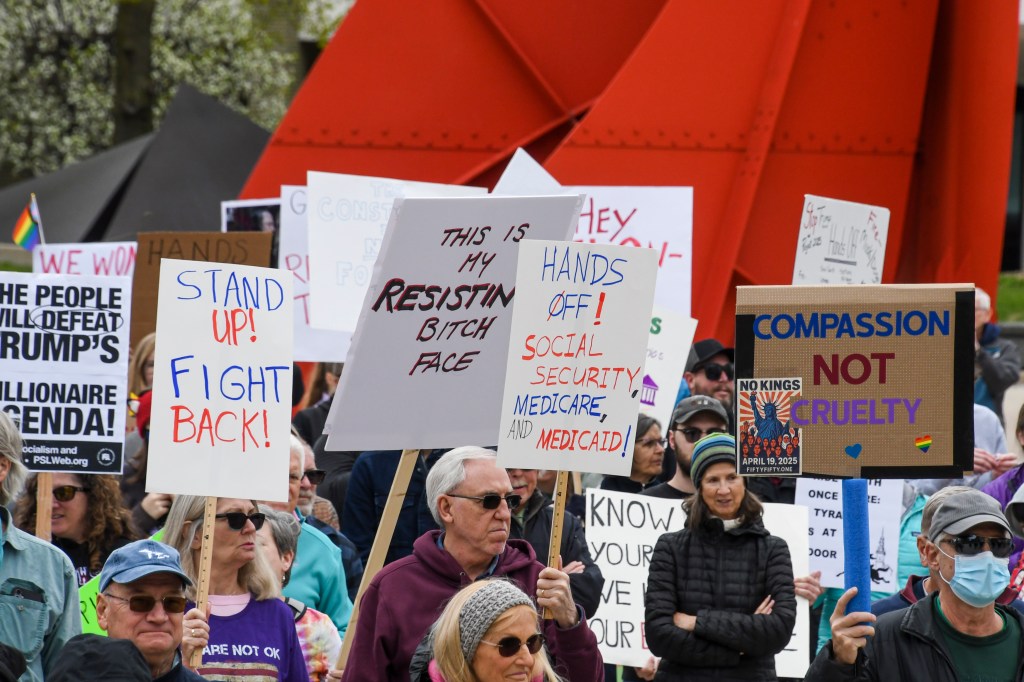
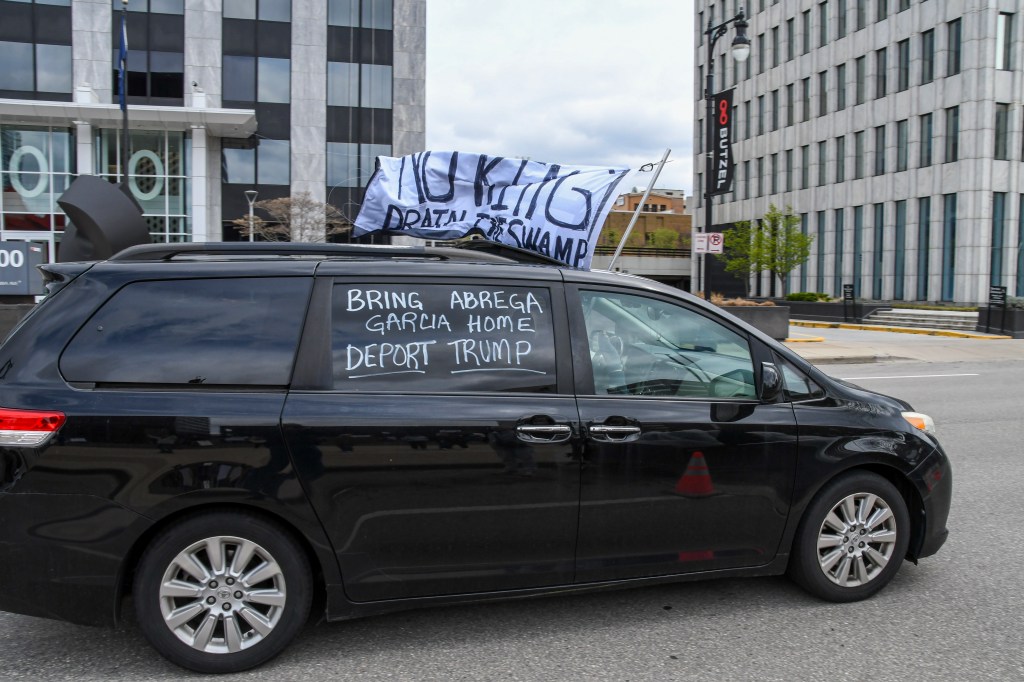
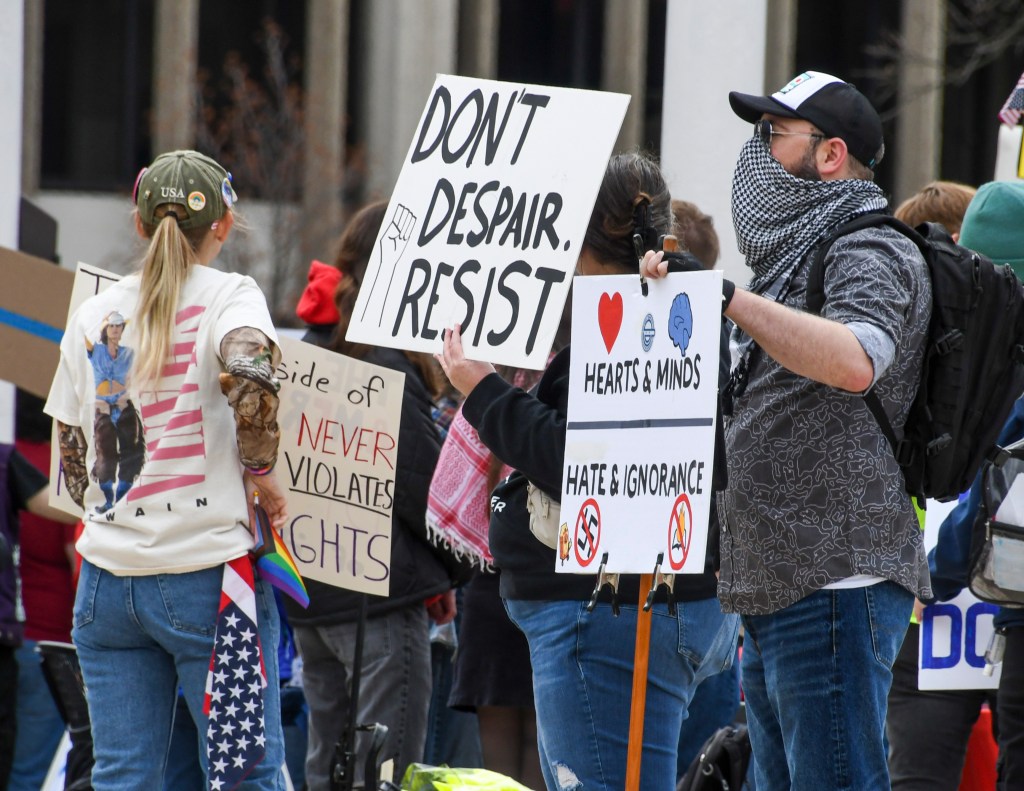
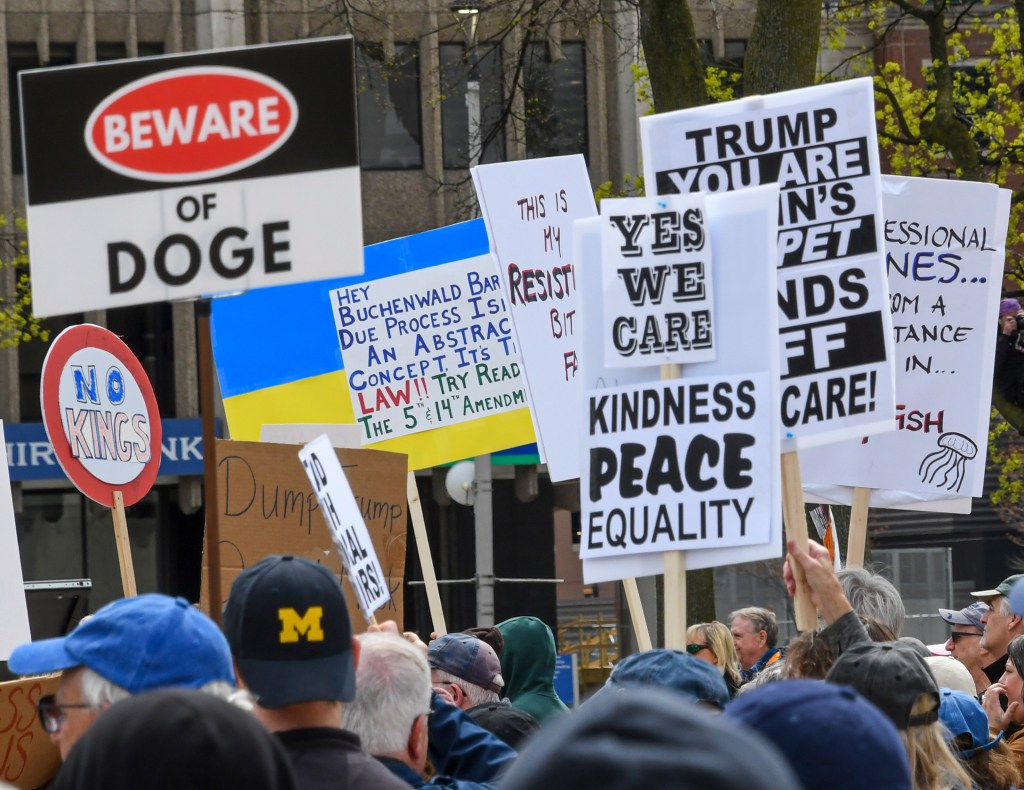
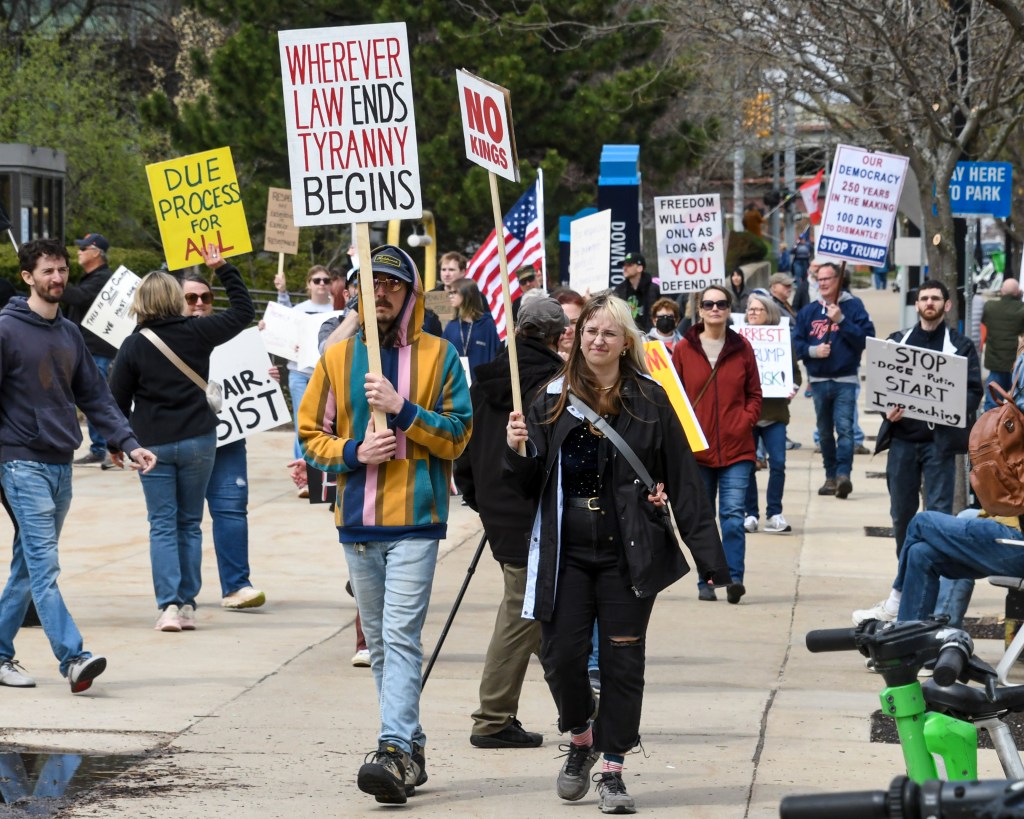
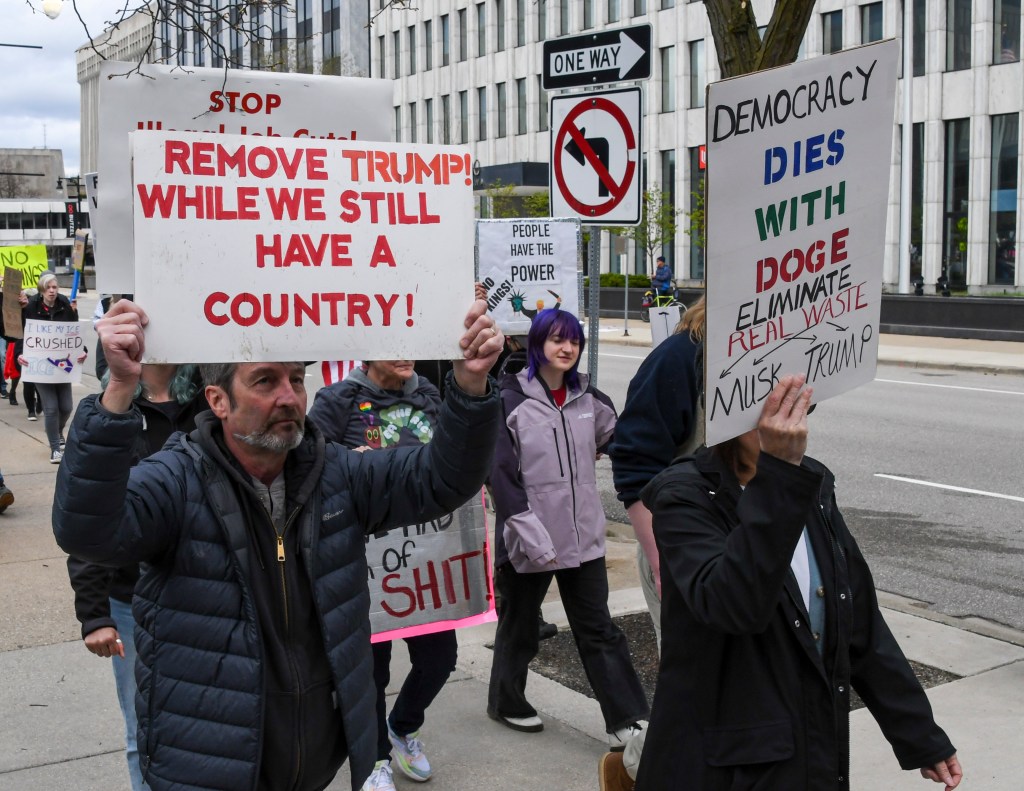
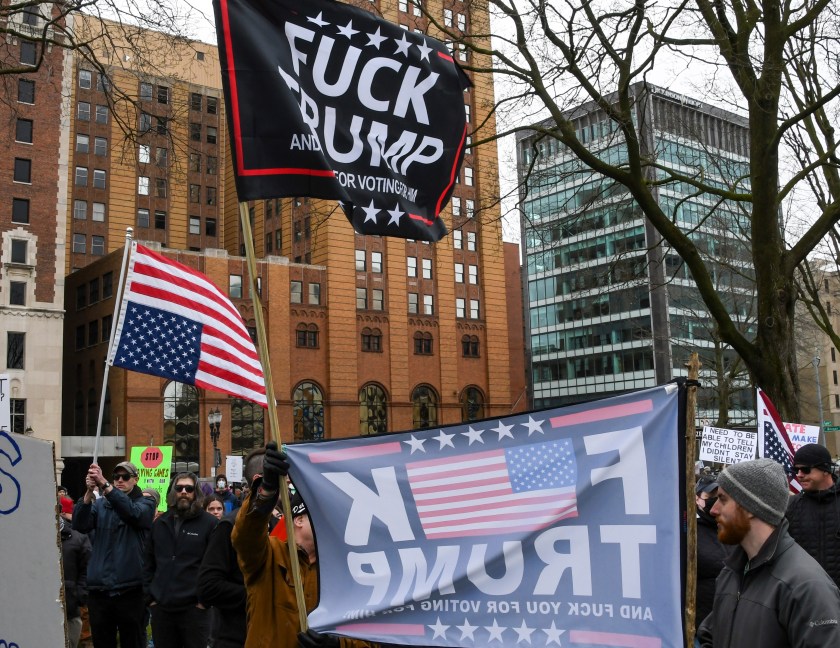
Grand Rapids, MI — Hundreds of voices rang out across Calder Plaza on Saturday afternoon April 20, 2025 as demonstrators gathered for “Picket the Plaza,” a protest against the Trump administration and what many described as a troubling direction for the country. The event, part of a nationwide day of action, drew people from all walks of life to downtown Grand Rapids in a unified call for justice, accountability, and the protection of civil rights.
Beginning with a powerful visual display, protesters lined bridges over Grand Rapids’ highways at noon, holding signs and waving to honking cars below. After an hour of peaceful bridge demonstrations, the crowd convened at Calder Plaza where the energy only grew louder.
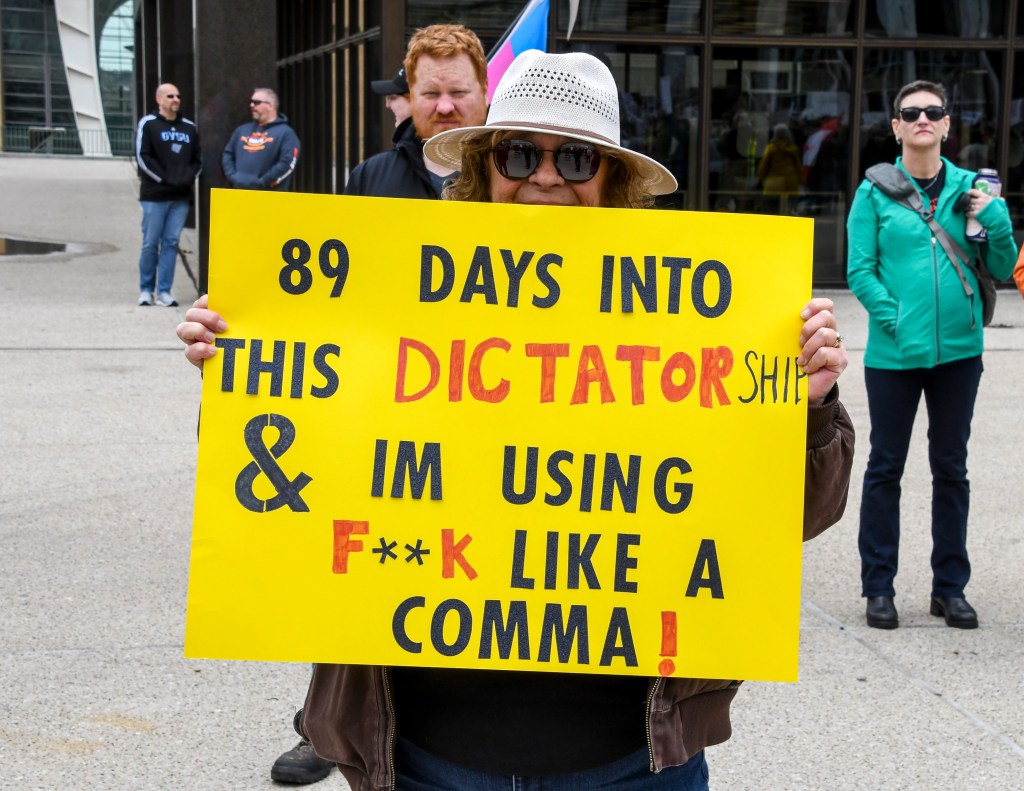
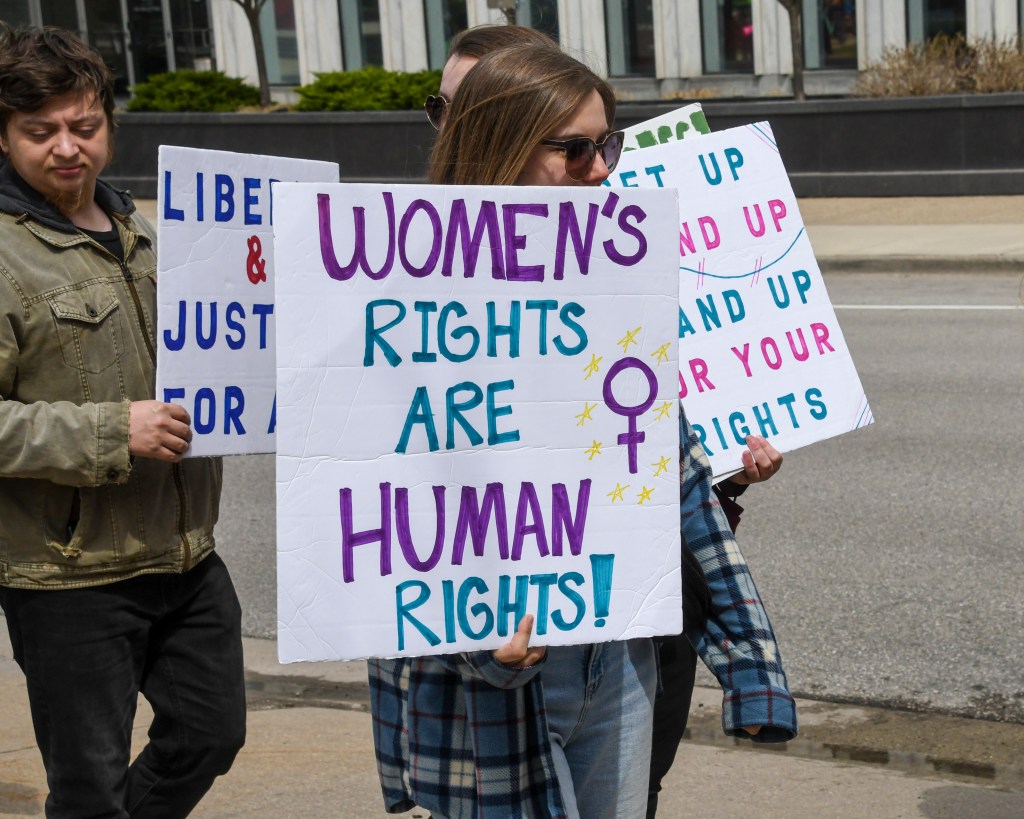
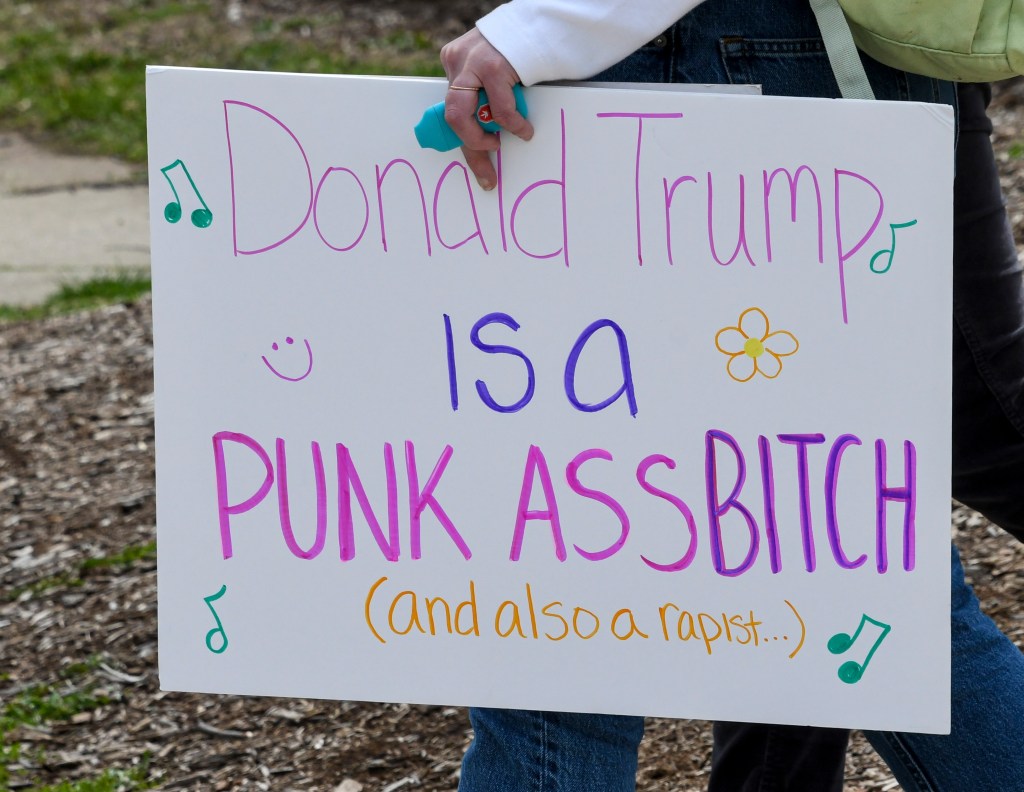
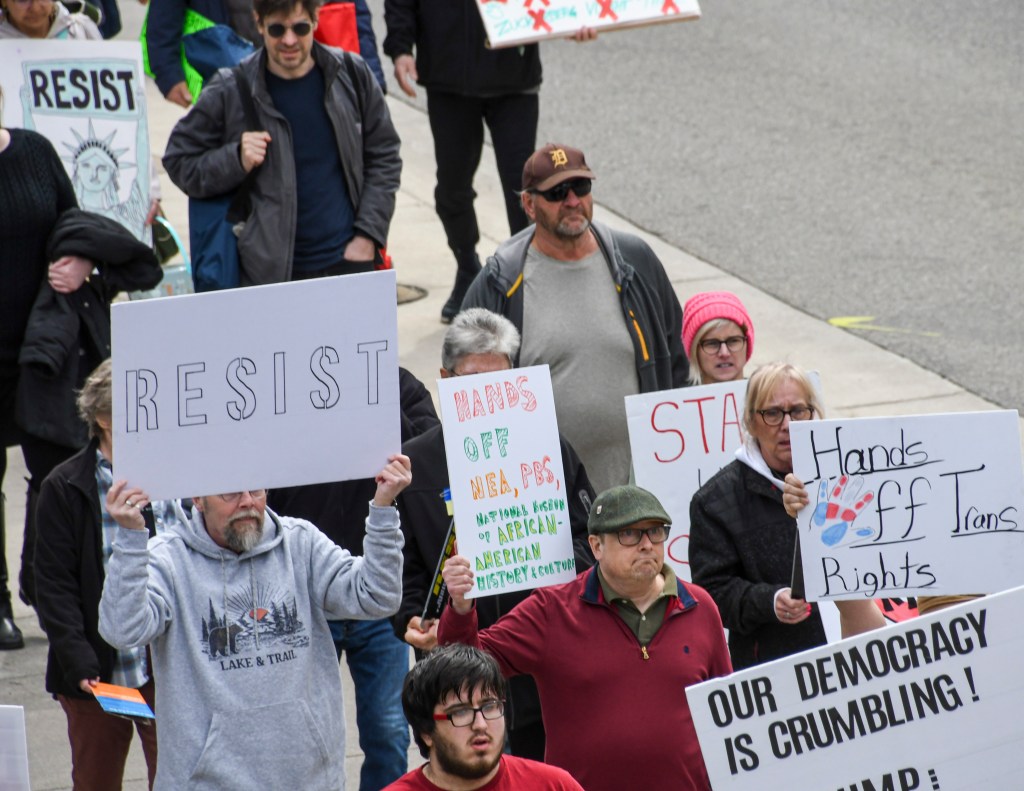
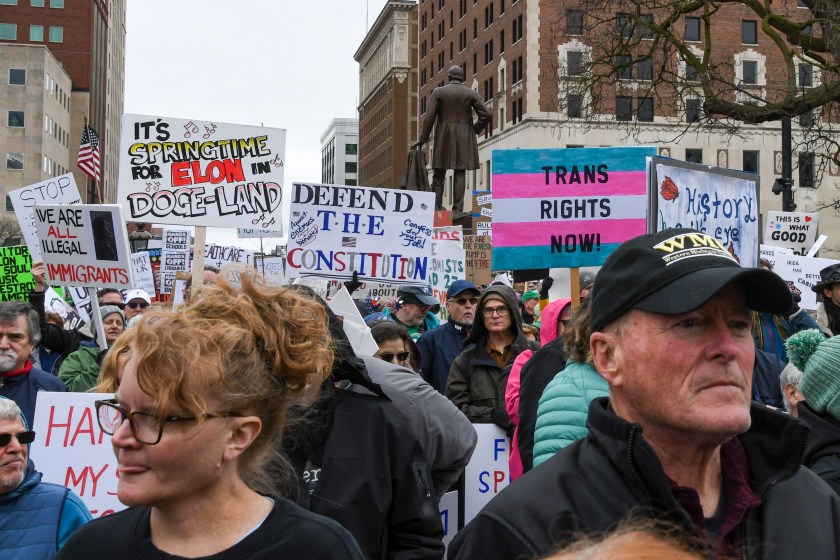
Messages of hope, frustration, and resistance filled the air, with signs bearing slogans like “Make love more contagious than measles,” “Disarm DOGE,” and “Everyone is innocent until proven guilty.” The chants echoed through the city blocks: “Hey hey, ho ho, Donald Trump has got to go,” and “Trans rights are human rights.”
“I care about everybody,” said protester Dee Jones, eyes filled with determination. “There’s a lot of injustice, inequities, and unethical things happening not just globally, but right here in the U.S. I’m sad. I’m disappointed. I’m angry. But I can do something. I can lead, and that’s why I’m here.”
Speakers took the stage to voice deep concern over President Trump’s influence and the direction of the Republican Party. Organizer Karen Dunnam didn’t mince words: “What’s going on in the Trump regime is not normal. It needs to be stopped, adjusted, rearranged—made palatable.”
Many attendees admitted it was their first time protesting, driven by what they see as an urgent need for action. Fear of rising authoritarianism and threats to democratic norms brought them out of their homes and into the streets.
From the bridges to the plaza, from chants to speeches, the message was clear: silence is not an option. As many people boldly declared, “It’s not the time to stay home—it’s time to take action.”
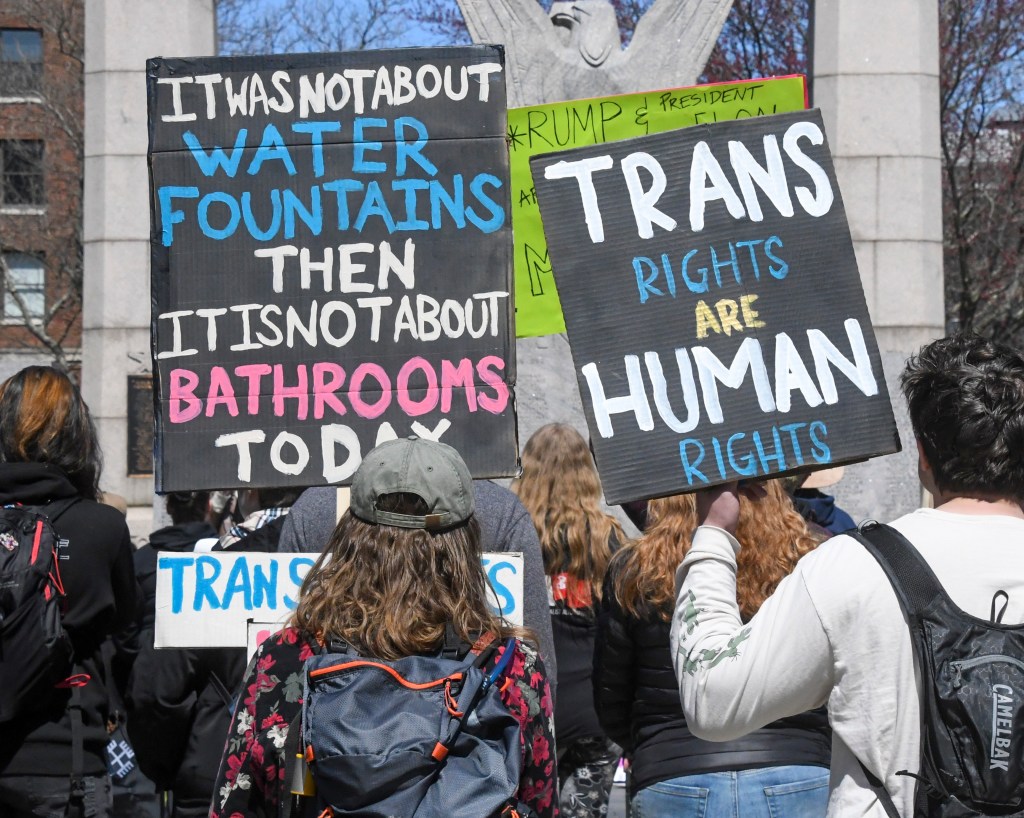
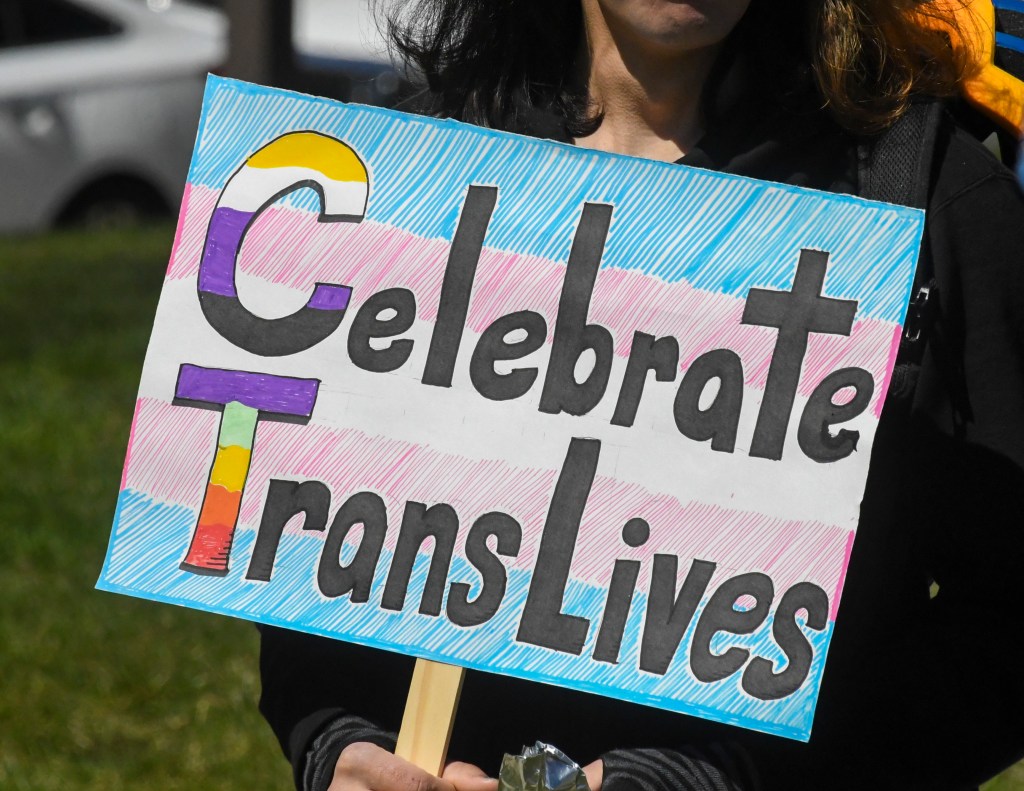
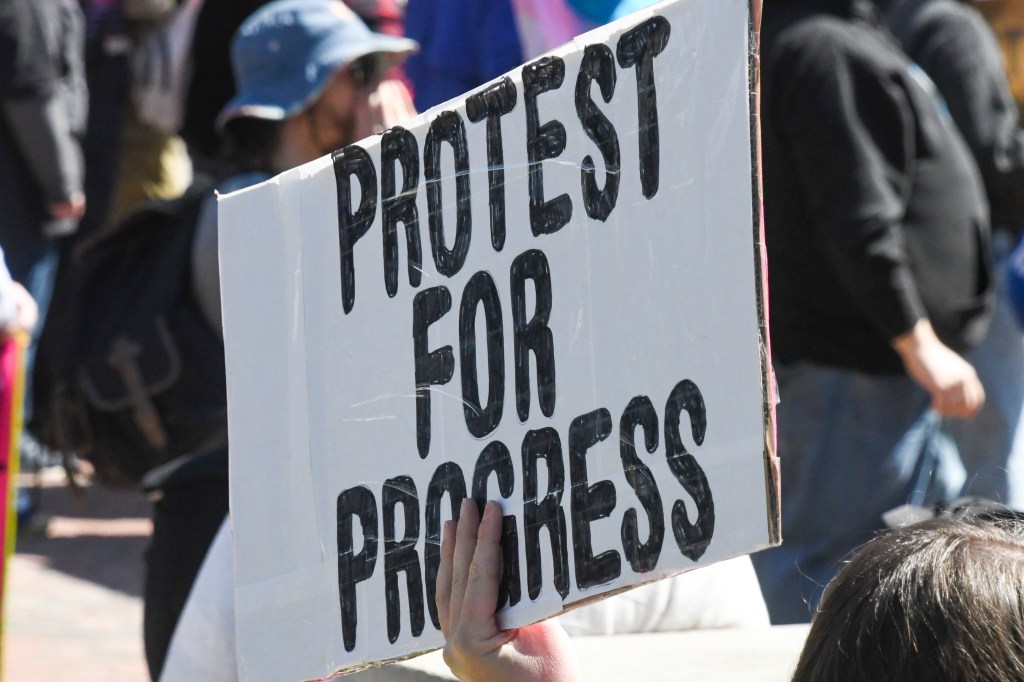
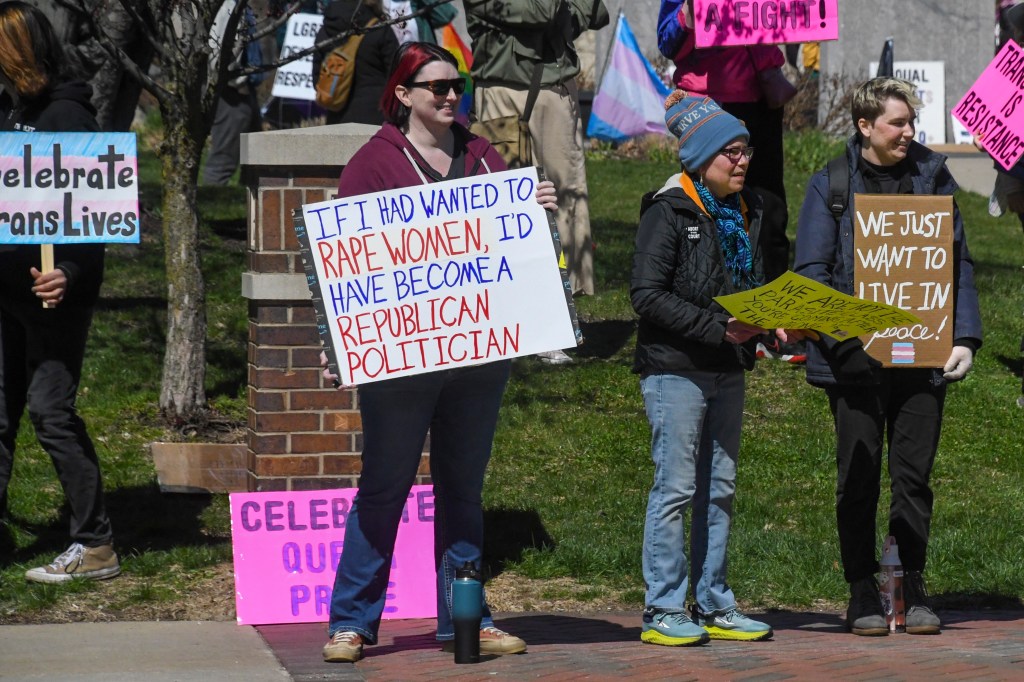
GRAND RAPIDS, MI — April 6, 2025 — A diverse crowd gathered Sunday at Veterans Memorial Park in downtown Grand Rapids for the “Protest For Progress: Trans Day of Visibility Rally.” The event aimed to shine a light on the lives and experiences of transgender, nonbinary, and gender-nonconforming individuals, and to call for increased visibility, protection, and understanding in a time of growing political tension.
The rally featured speeches from community members, activists, and advocates, many of whom spoke passionately about the challenges facing trans individuals in the current political climate. The central theme throughout the afternoon was clear: trans people are here, they are real, and they deserve to live openly and without fear.
One speaker captured the spirit of the day in a powerful spoken word-style message: “We are vast like an open sea and lonely like an elegy. We are visibility. We are more than we appear, more than objects in your mirror. We are alive and we are here. We are real and we are queer.”
Attendees emphasized that Trans Day of Visibility is not just a celebration, but also a call to action. “We’re here to be visible. We’re here to be seen,” said another speaker. “And we’re here to look at the world and say: trans people are real, and you will absolutely never bully us out of existence.”
Organizers and participants voiced concern about what they view as a growing wave of anti-trans legislation across the United States. According to multiple advocacy groups, dozens of states have introduced bills in recent years that would restrict healthcare access, participation in public life, and legal recognition for transgender individuals.
While the rally primarily focused on trans rights, some speakers connected the struggle to broader global and domestic issues. References were made to the plight of civilians in Gaza, challenges faced by immigrants, and violence against women worldwide—highlighting a shared resistance to what speakers described as “systems of oppression.”
One participant remarked, “We can only fight transphobia by fighting against racism, sexism, and all the other forms of oppression. Likewise, we can only fight oppression, ultimately, by uniting our movements.”
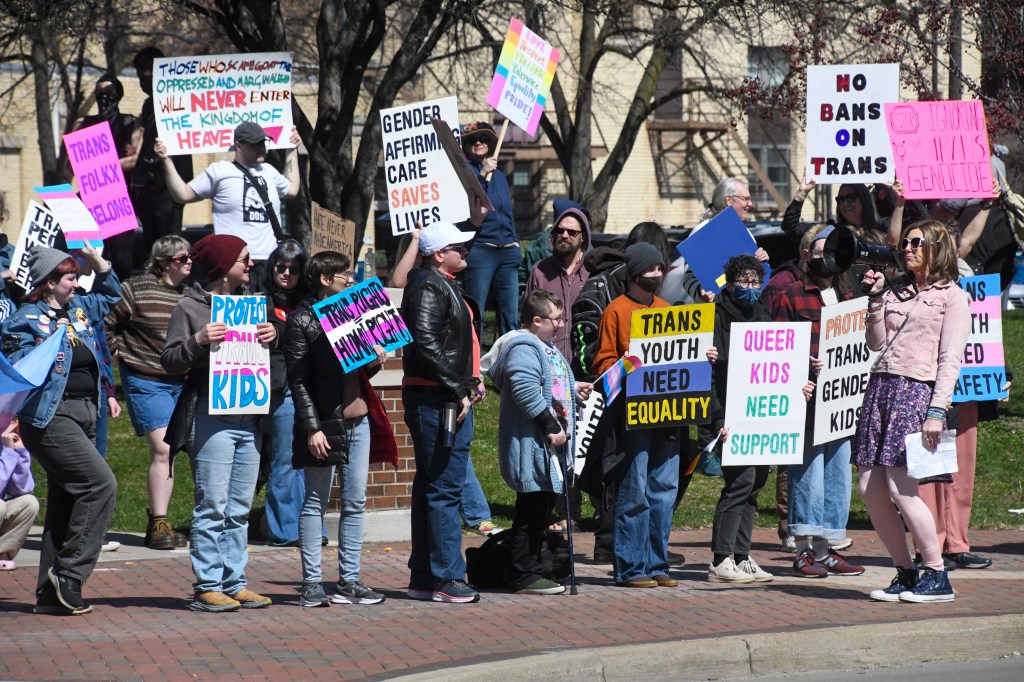
Following the speeches, demonstrators lined Fulton Street in front of the park, waving LGBTQ+ flags and holding handmade signs with slogans such as “Protect Trans Youth,” “Celebrate Trans Lives,” “Trans is beautiful” and “Trans Rights Are Human Rights.” Chants echoed across downtown as passing drivers honked in solidarity.
Sunday’s rally was a visible and vocal display of support for transgender rights in Grand Rapids, reinforcing the belief among many attendees that showing up and speaking out remains more important than ever.
The event concluded peacefully, with attendees encouraging one another to stay active, stay hopeful, and stay visible.
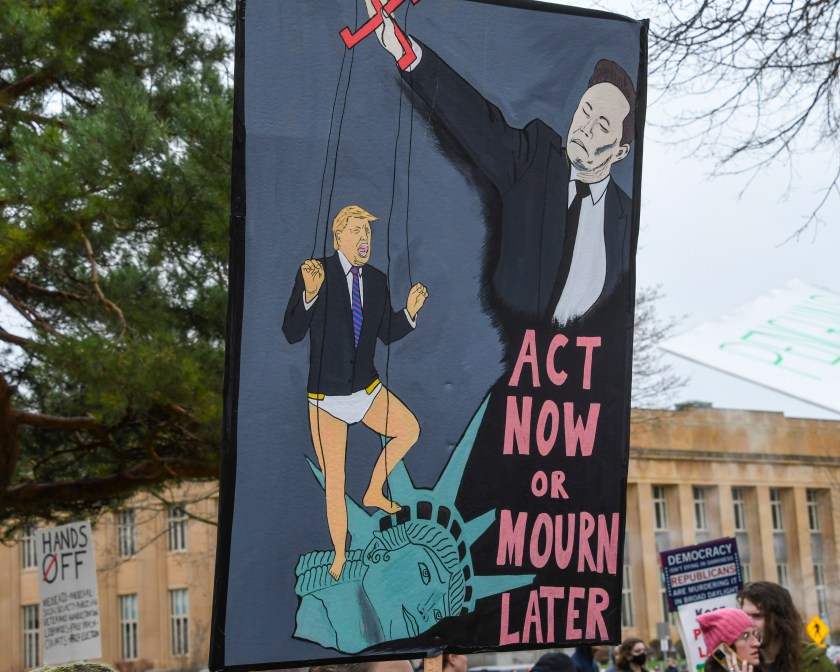
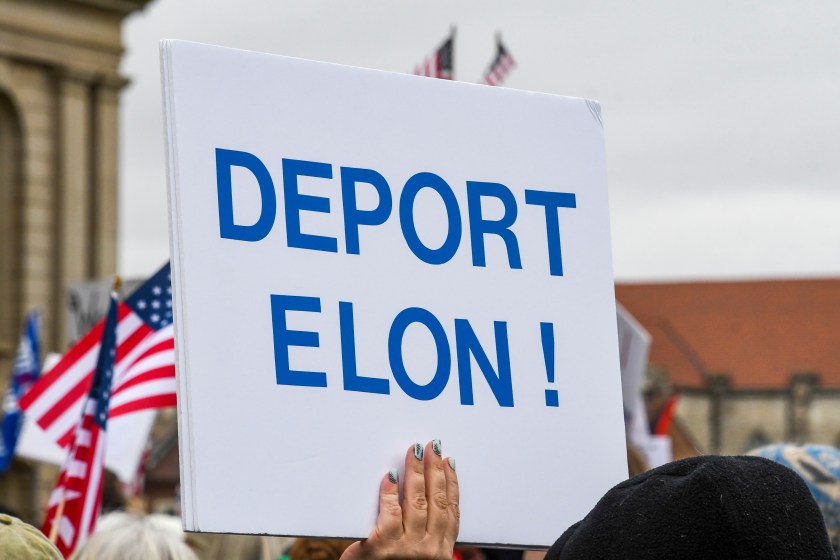
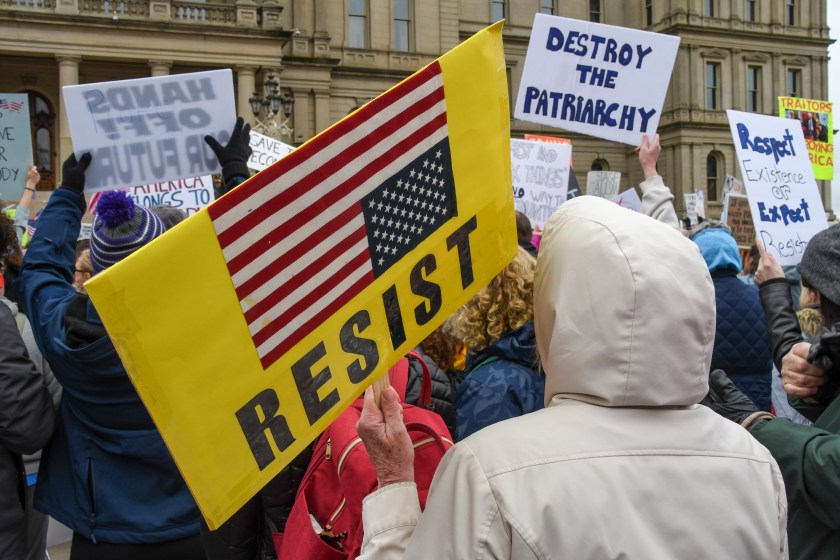
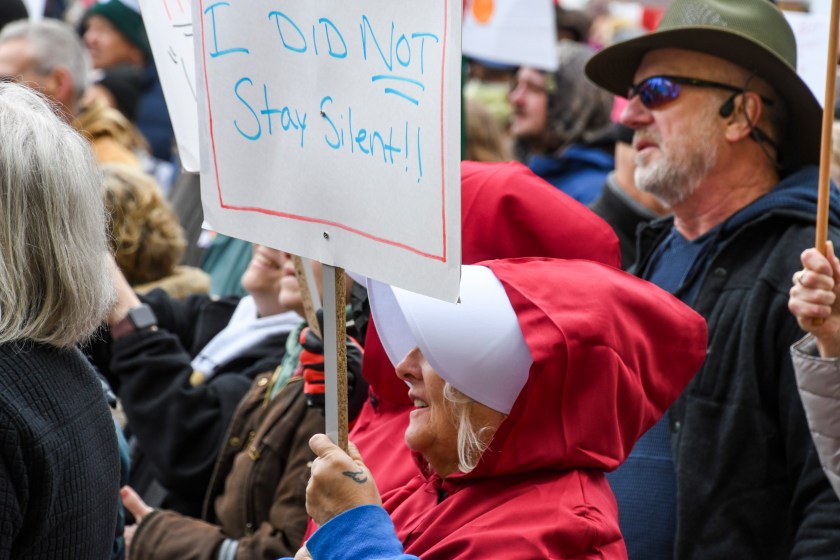
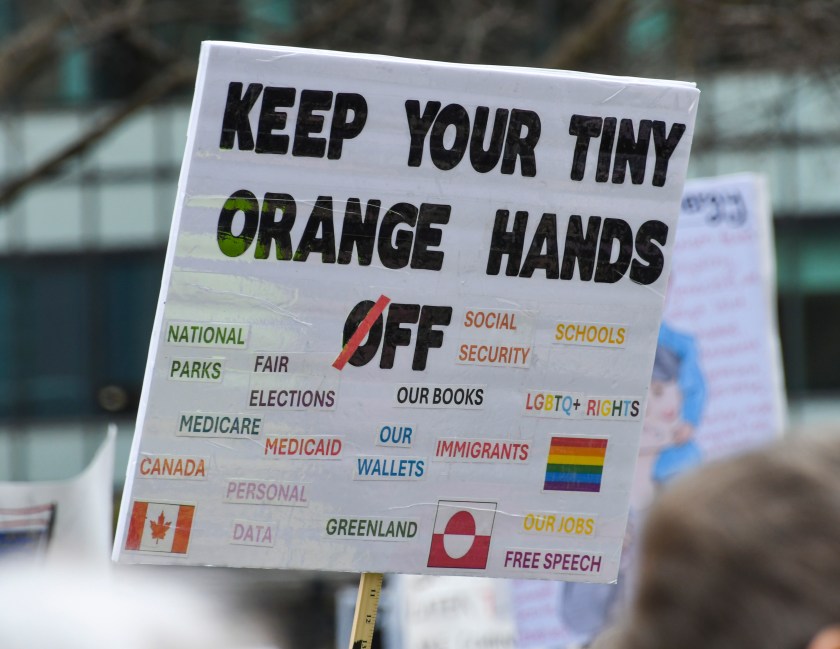
LANSING, Mi. — April 5, 2025 — Today in Lansing, the lawn of Michigan’s Capitol transformed into a sea of handmade signs, booming chants, and collective outrage. Thousands of demonstrators gathered on Saturday as part of a nationwide “Hands Off!” protest against what organizers call a “billionaire power grab” by President Donald Trump and his top adviser, Elon Musk.
The protest was just one of over 50 rallies held across the state—including in Detroit, Grand Rapids, Ann Arbor, and Kalamazoo—making it Michigan’s largest coordinated political action of the year. And maybe the biggest anti-Trump turnout in his second term so far.
“This isn’t just about politics,” said former U.S. Senator Debbie Stabenow from the Capitol steps. “It’s about defending democracy and standing up for the people who keep this country running.”
She wasn’t alone. Michigan’s Lieutenant Governor Garlin Gilchrist II and Attorney General Dana Nessel also took the mic, calling out what they described as dangerous federal rollbacks under Musk’s new role in the Trump administration.
Wait—Elon Musk in government? Yep. Earlier this year, Trump appointed Musk as head of the newly created Department of Government Efficiency. Since then, that department has slashed thousands of federal jobs, closed Social Security offices, and gutted funding for housing, education, and health programs. The administration calls it “streamlining.” Protesters call it what it looks like: privatization on steroids.
“Elon Musk doesn’t belong anywhere near our government,” said Tina Rivera, a protester from Flint. “He’s trying to run the country like a startup. Real people are getting hurt.”
Many protesters carried signs that read:
“Hands Off Our Future”
“86 47“
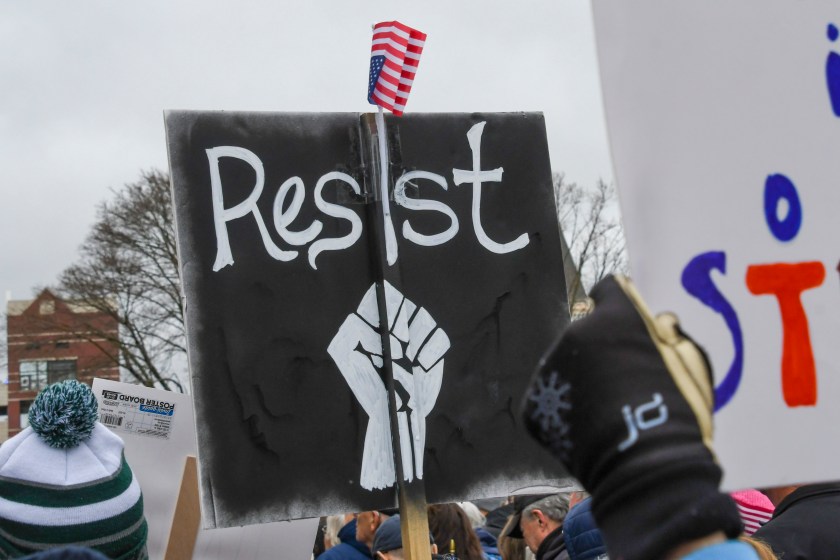
“Resist”
Impeach Trump
Deport Musk
From retirees to high school students, union members to immigrant rights activists, the crowd was diverse—and united.
And while much of the focus was on federal cuts, speakers also sounded alarms about new tariffs threatening Michigan’s manufacturing industry, and the chilling effect on public education funding.
Many protesters feel that “Elon Musk is making massive decisions about our lives—and no one elected him.Chanting That’s not democracy. That’s corporate control.”
The protest was organized by the grassroots 50501 Movement, in coalition with over 200 national and local organizations. And according to spokesperson Maya Jordan, this isn’t the end. “People are angry, they’re awake, and they’re ready. Today was just the beginning.”
As the rally wound down, chants of “Hands off our future!” echoed across the Capitol lawn. And from the energy in the crowd, it’s clear: this movement isn’t backing down.
“This isn’t a one-time thing,” Several people told me. “We’re going to keep showing up, because this government is supposed to work for us—not the billionaires.”
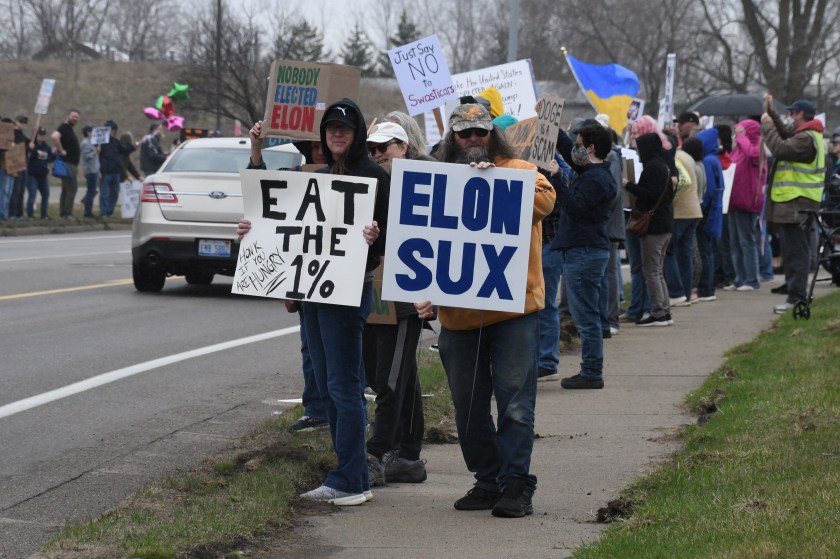
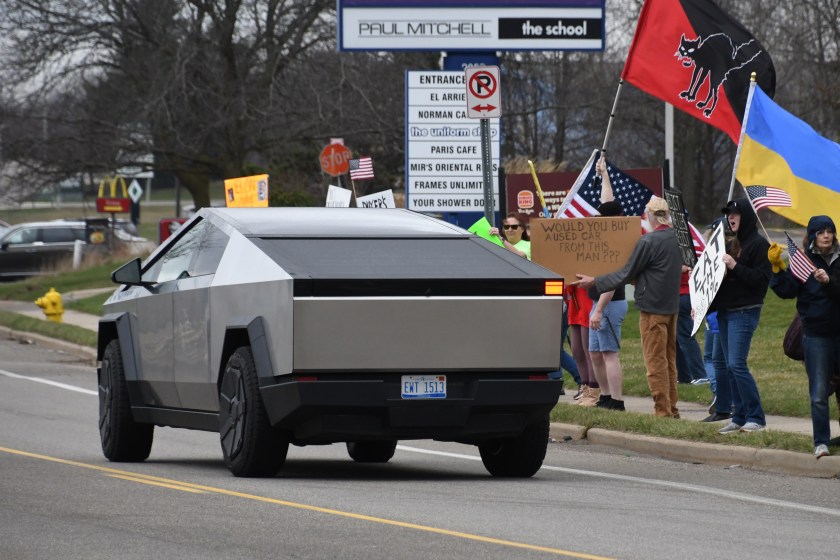
Grand Rapids, MI — Hundreds of protesters lined the sidewalk in front of the Tesla dealership on 29th St. Ave. SE in Grand Rapids on Saturday, March 29, as part of a nationwide demonstration against the electric vehicle giant.
The protest, dubbed “Tesla Takedown,” was one of many held across the country over the weekend in opposition to Tesla CEO Elon Musk’s expanding political influence. Specifically, demonstrators targeted Musk’s role as the head of the newly created Department of Government Efficiency (DOGE)—a position that has granted him access to sensitive federal data and the authority to shut down entire government agencies in an aggressive push to cut spending.
Musk, whose estimated $340 billion fortune is largely tied to his Tesla holdings, continues to lead the company while simultaneously working alongside former President Donald Trump. Critics argue that his growing influence is a threat to democratic institutions.
Protesters held signs with slogans such as “No Kings, No Felons,”“Don’t Buy Swasticars,” and “Tesla is Funding the Coup.” Organizers say this is just the beginning of a larger movement aiming to challenge Musk’s role in both business and politics.
With additional demonstrations planned, the “Tesla Takedown” movement signals escalating public concern over the intersection of corporate power and government control.
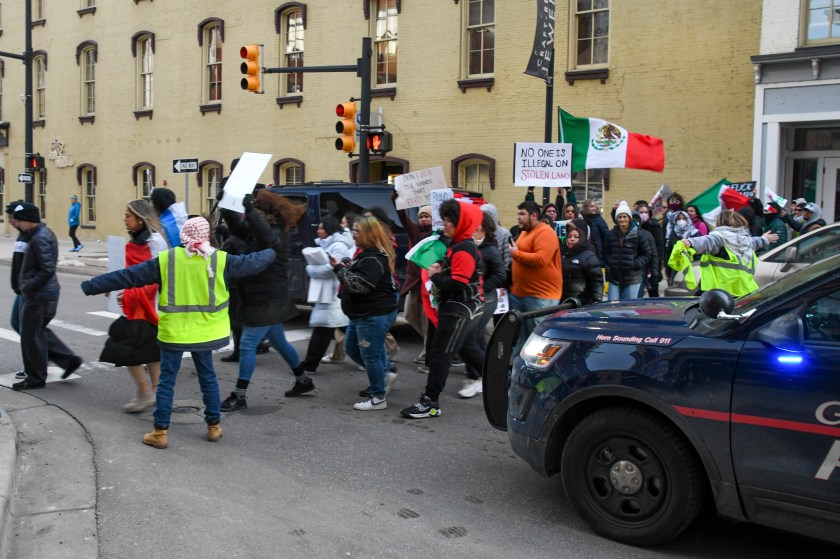
Marcher line up to take to the streets of Grand Rapids
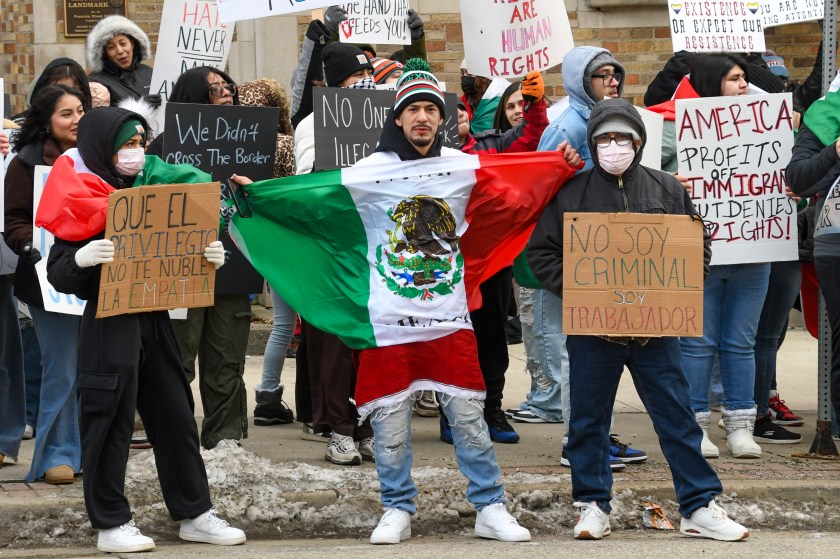
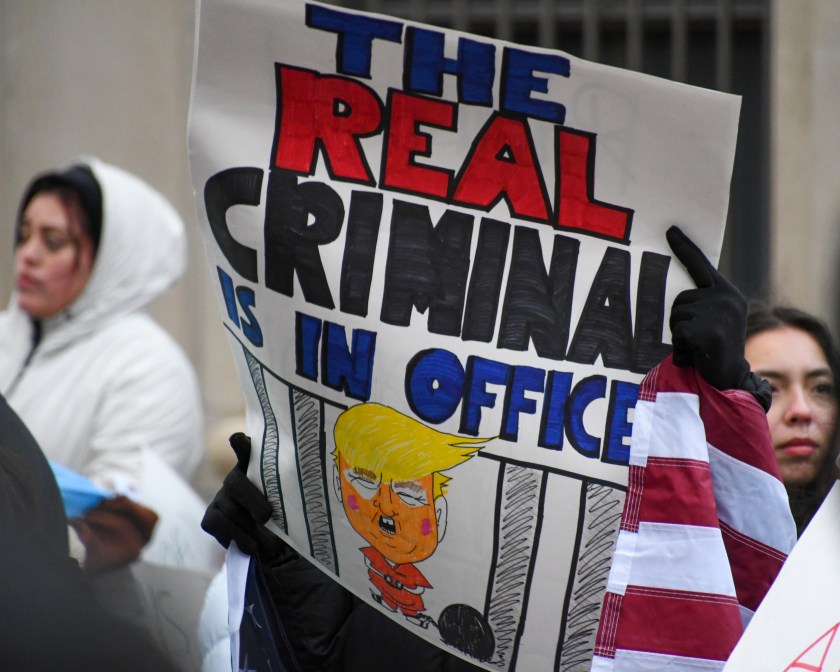
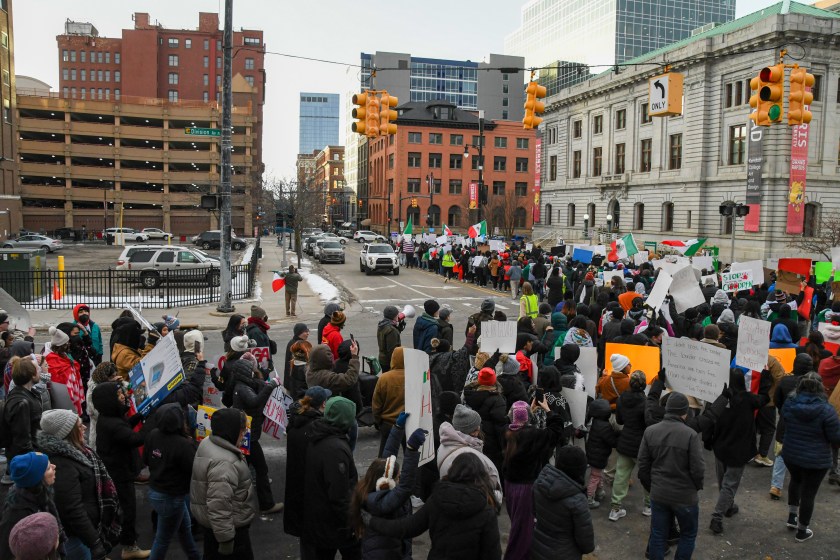
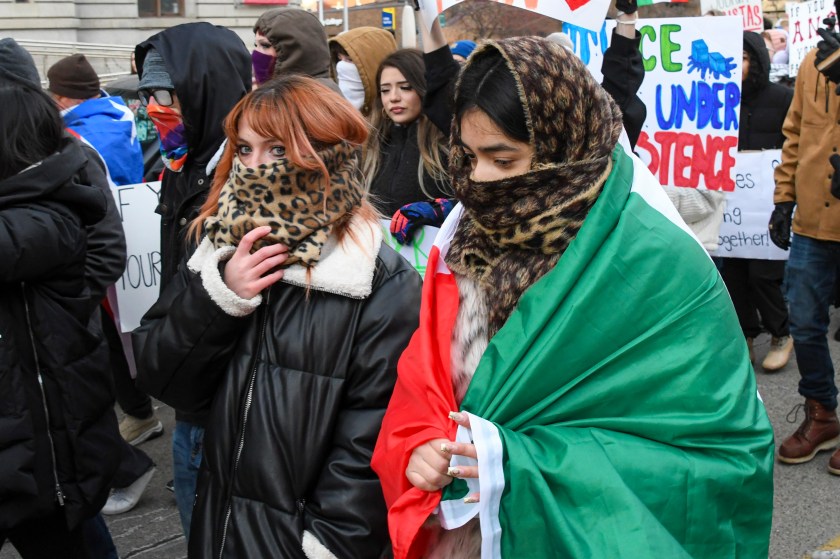
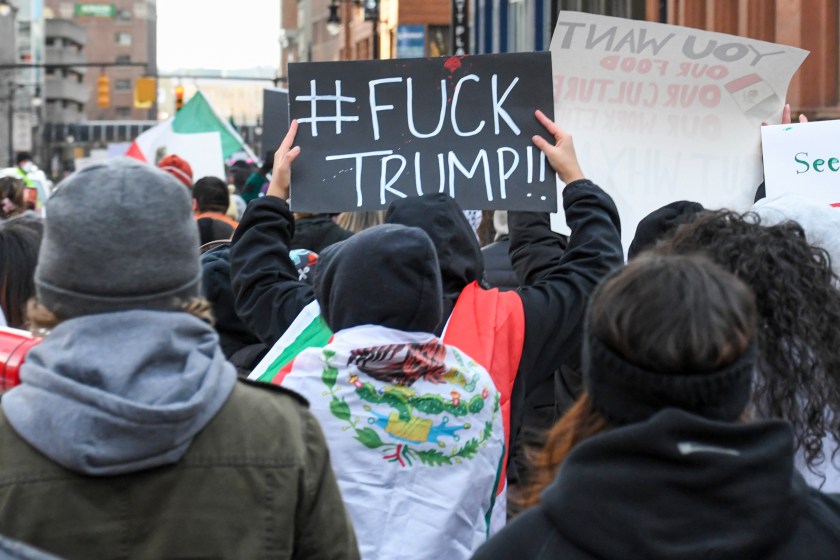
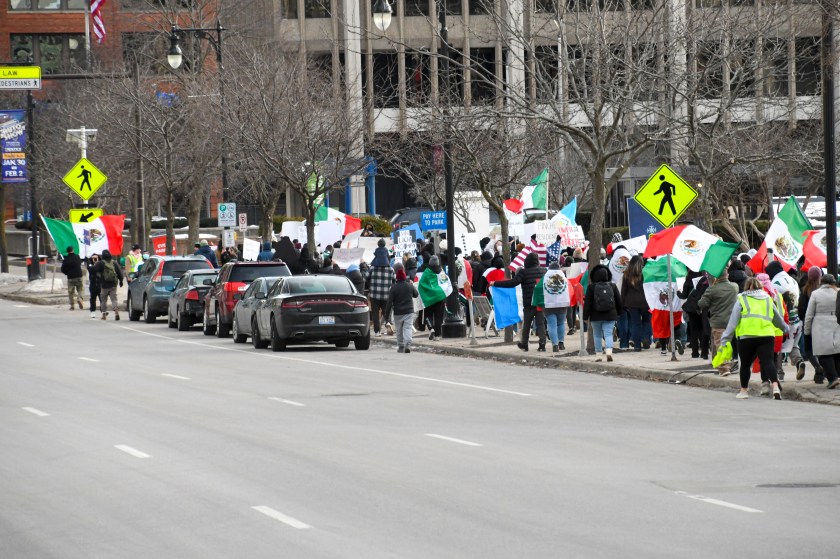
GRAND RAPIDS — The streets of downtown Grand Rapids echoed with chants of “¡Sí se puede!” and “Aquí estamos” on the afternoon of Saturday, February 1, as hundreds of demonstrators gathered for the Stand Up & Fight Back rally. Organized by the Grand Rapids Alliance Against Racist and Political Repression (GRAARPR), the rally aimed to highlight issues impacting marginalized communities under the current administration, particularly immigrant rights and Palestinian lives.
The demonstration began at Fountain Street Church, where local organizers and community leaders addressed the crowd before leading a march through downtown. Protesters held signs high and voiced their concerns over policies they believe disproportionately affect immigrants, people of color, LGBTQ+ individuals, and other vulnerable groups.
Among the marchers was Marianna Silva, who attended the rally in honor of her immigrant parents. “My parents are immigrants, but it’s okay. They’re out here making the world better for me,” Silva said. “It actually makes my heart bigger. It makes my heart melt. There are so many people out here who have immigrant parents, and they’re standing in solidarity. That’s how it should always be.”
Yasmin Montoya echoed that sentiment, saying she was marching to be a voice for her parents. “I want to be their voice, since they really can’t use theirs as much as they’d like to. I’m here to advocate for them and for our community,” Montoya said. “It’s a blessing to see so many people coming together to support one another.”
For Sherlyn A., the event was an emotional experience shared across borders. “My parents came to this country legally, and they work hard every day,” she said. “I was just on FaceTime with my dad, showing him all the people who came out to support. He looked like he wanted to cry.”
The rally brought together over a dozen organizations, including Planned Parenthood, Palestine Solidarity Grand Rapids, and GR Rapid Response to ICE. Organizers emphasized the importance of unity among different movements fighting for justice.
“We have to stand in solidarity with all these different movements,” said Julian Cortez of GRAARPR. “We’ve already seen a lot of executive orders, and we see the direction this administration wants to take the country. We are standing here to say we are not going to take it.”
Cortez highlighted that the fight is far from over. “We are here standing in solidarity with the Two-Spirit LGBTQ+ community, with Palestinians, with Black lives, and with workers’ rights. This is only the beginning.”
Saturday’s rally marked the first large-scale protest in Grand Rapids since the new administration took office, but organizers made it clear it would not be the last.
“We cannot let fear make us apathetic,” one organizer told the crowd. “Let’s make 2025 the people’s year.”
As the marchers returned to Fountain Street Church, the energy remained high, with many attendees discussing ways to stay involved and continue the fight for human rights. With the momentum gained from this event, activists in Grand Rapids are making it clear: they are ready to stand up, fight back, and keep pushing for change.



































































 Media Works of John Rothwell